
If you walk into a manufacturing plant, water treatment facility, cement unit, or packaging factory, you’ll find hundreds of rotating machines working together every day. Motors drive pumps, pumps drive conveyors, and conveyors keep production moving.
What many people don’t notice is the small component sitting between two shafts that quietly keeps everything running smoothly. That component is the Jaw Coupling.
Despite the availability of advanced coupling technologies, jaw couplings remain one of the most widely used power transmission solutions because they are simple, reliable, and economical.
The Real Problem Industrial Machinery Faces
In an ideal world, two shafts would always remain perfectly aligned.
In reality, that rarely happens.
During operation, machines experience:
- Vibration
- Minor shaft movement
- Thermal expansion
- Shock loads
- Installation inaccuracies
When these forces are transferred directly from one shaft to another, bearings wear faster, seals fail prematurely, and maintenance costs increase.
This is where a Jaw Coupling becomes valuable.
So, What Exactly is a Jaw Coupling?
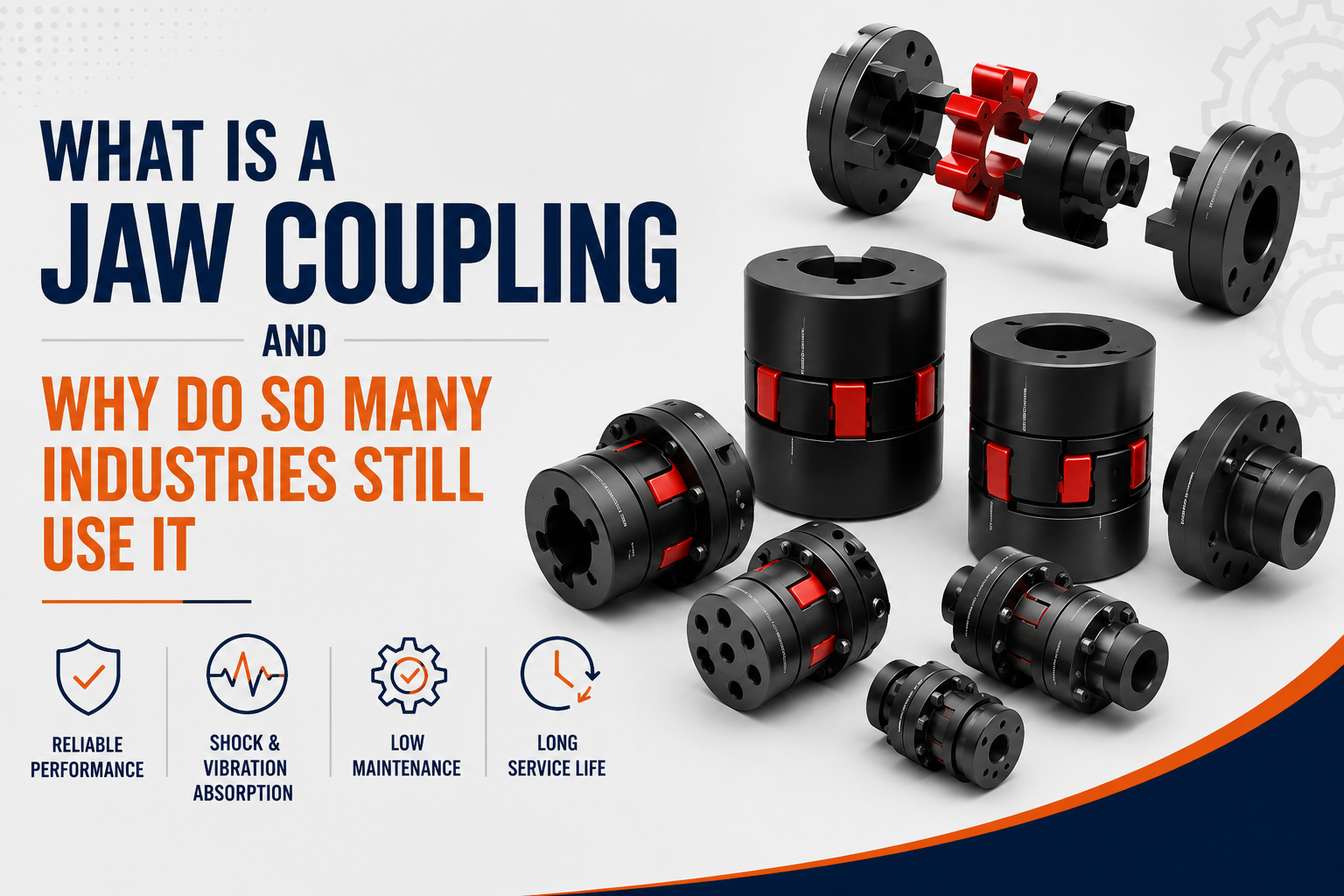
A Jaw Coupling is a flexible shaft coupling made up of two metallic hubs and an elastomer spider positioned between them.
As torque passes from the driving shaft to the driven shaft, the spider cushions the transmission process.
Instead of allowing metal-to-metal contact, the elastomer element absorbs vibration and reduces sudden load impacts.
This makes jaw couplings particularly effective in industrial environments where equipment operates continuously.
Why Maintenance Teams Prefer Jaw Couplings
Ask most maintenance engineers why they use jaw couplings and the answer is usually simple:
“They work, and they don’t create problems.”
Some of the practical benefits include:
- Reduced vibration transmission
- Lower bearing wear
- Protection against shock loading
- Easy spider replacement
- Minimal maintenance requirements
- Cost-effective ownership
For facilities operating multiple machines, these advantages can significantly reduce downtime throughout the year.
Where Are Jaw Couplings Commonly Used?
Jaw couplings are found across a wide range of industries because they can handle varying loads and operating conditions.
Typical applications include:
Pump Systems
Used in water treatment plants, chemical processing units, and industrial pumping stations.
Compressors
Help reduce vibration and protect connected equipment.
Conveyor Systems
Provide reliable torque transmission in manufacturing and material handling operations.
Fans and Blowers
Support smooth operation while minimizing mechanical stress.
Packaging Machinery
Used where reliability and low maintenance are important.
When Should You Consider Another Coupling Type?
Although jaw couplings are highly versatile, certain applications may require specialized solutions.
For larger misalignment requirements, an Alignment Eliminator may be more suitable.
Where constant rotational speed through angular displacement is critical, a Constant Velocity Joint can provide better performance.
Heavy-duty torque applications may benefit from a Hydax Coupling depending on operating conditions.
Selecting the right coupling always depends on torque, speed, environment, and alignment requirements.
The Bottom Line
A Jaw Coupling is not the most complex component in a power transmission system, but it is often one of the most important.
By reducing vibration, absorbing shock loads, and protecting connected equipment, it helps improve machine reliability and lower maintenance costs.
That is why jaw couplings continue to be used in pumps, compressors, conveyors, fans, and manufacturing machinery across a wide range of industries.
For companies seeking dependable industrial power transmission solutions, jaw couplings remain one of the most practical and proven choices available today.
FAQ Section
1. Our pump motor setup is creating excessive vibration. Can a Jaw Coupling help?
Yes. Excessive vibration is one of the most common issues in pump and motor systems. A Jaw Coupling uses an elastomer spider that absorbs vibration before it reaches connected equipment. This helps protect bearings, seals, and shafts while improving overall machine stability.
2. We frequently replace bearings due to shaft misalignment. What is the solution?
Minor shaft misalignment can significantly reduce bearing life. A Jaw Coupling is designed to accommodate limited angular, parallel, and axial misalignment, reducing stress on bearings and extending equipment lifespan. However, severe misalignment should still be corrected during installation.
3. Our conveyor experiences sudden shock loads during startup. Will a Jaw Coupling reduce equipment damage?
Yes. Jaw Couplings are widely used in conveyors because the elastomer spider absorbs shock loads generated during startup and stopping cycles. This cushioning effect helps protect motors, gearboxes, and driven equipment from sudden torque spikes.
4. We need a coupling that is easy to maintain and does not require frequent servicing. Is a Jaw Coupling suitable?
A Jaw Coupling is often chosen for low-maintenance applications. The coupling has a simple design, and the spider can be replaced quickly without replacing the entire coupling assembly. This reduces maintenance time and minimizes production downtime.
5. Our manufacturing machine produces noise and uneven operation. Could the coupling be the reason?
In many cases, yes. Worn or improperly selected couplings can transfer vibration and create operational noise. Replacing the existing coupling with a properly sized Jaw Coupling can improve torque transmission, reduce vibration, and create smoother machine operation.


