
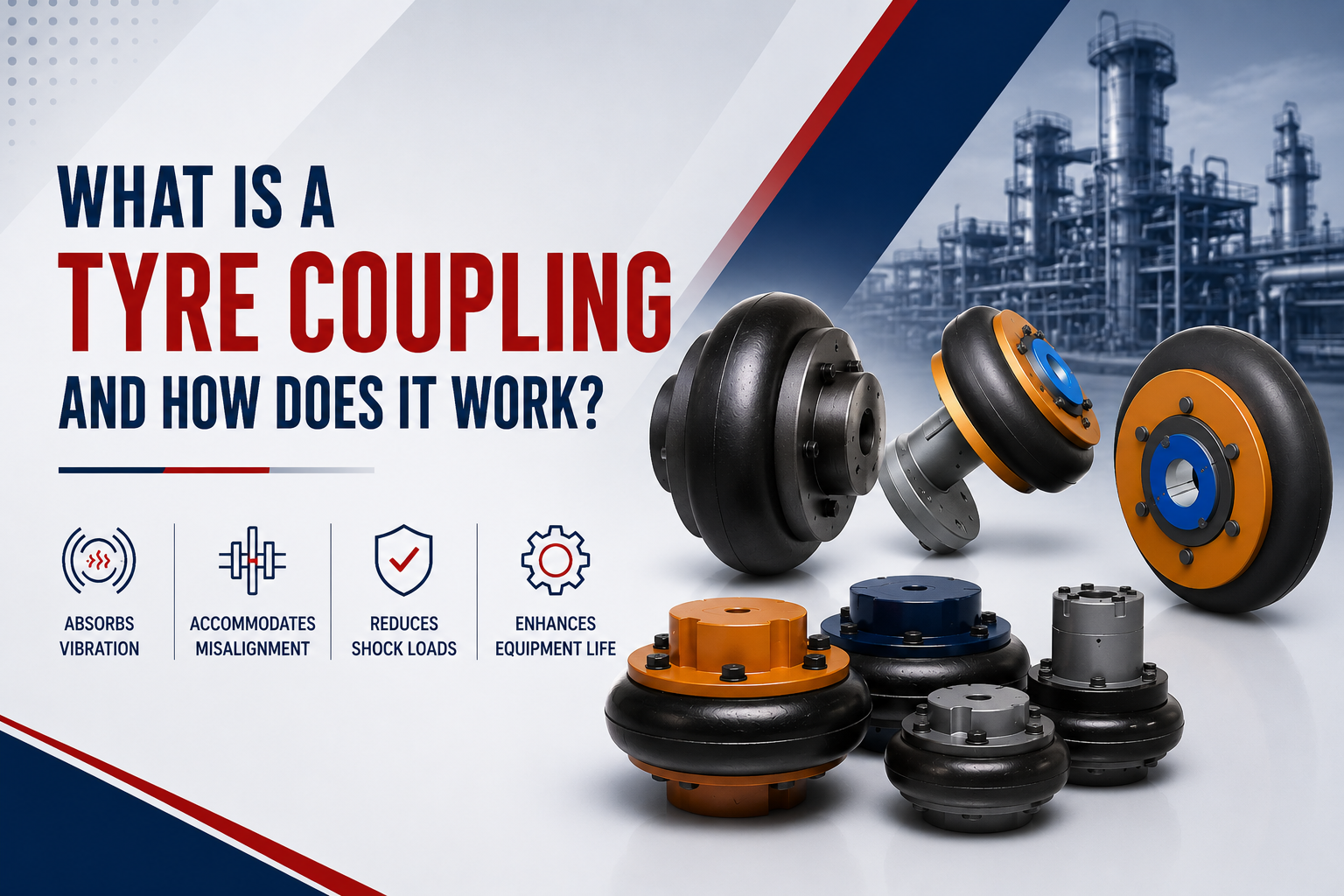
Industrial machinery operates under demanding conditions where vibration, shock loads, and shaft misalignment are common challenges. To maintain smooth power transmission and protect connected equipment, industries use various types of flexible couplings. Among them, the Tyre Coupling is one of the most widely used solutions due to its ability to absorb vibration and accommodate shaft movement.
From conveyor systems and pumps to compressors and industrial drives, tyre couplings help improve machinery performance while reducing wear on critical components. Their simple design, low maintenance requirements, and excellent flexibility make them a preferred choice across multiple industries.
What is a Tyre Coupling?
A tyre coupling is a flexible shaft coupling that uses a reinforced rubber element shaped like a tyre to connect two hubs. The rubber tyre acts as the flexible member, transmitting torque while absorbing shock loads and compensating for shaft misalignment.
Unlike rigid couplings, tyre couplings can handle:
• angular misalignment
• parallel misalignment
• axial movement
• vibration and shock loads
Because of these capabilities, tyre couplings are commonly used in industrial power transmission systems where equipment reliability is critical.
How Does a Tyre Coupling Work?
The working principle of a tyre coupling is simple yet highly effective.
The coupling consists of two metallic hubs connected by a flexible rubber tyre element. When the driving shaft rotates, torque is transferred through the rubber tyre to the driven shaft.
The tyre element performs several important functions:
• transmits rotational power
• absorbs vibration
• reduces shock loads
• compensates for shaft movement
• protects connected machinery
This flexibility helps prevent excessive stress on bearings, motors, gearboxes, and shafts.
Key Benefits of Tyre Couplings
Excellent Vibration Damping
One of the biggest advantages of tyre couplings is their ability to absorb vibration before it reaches connected equipment.
Benefits include:
• smoother operation
• reduced equipment wear
• lower noise levels
• improved machine life
Handles Shaft Misalignment
Industrial machinery rarely remains perfectly aligned throughout operation. Temperature changes, foundation movement, and load variations can create shaft movement.
Tyre couplings help compensate for these conditions without affecting performance.
Reduced Maintenance Requirements
Since the tyre element absorbs most operational stress, machinery components experience less wear and tear, helping reduce maintenance costs and downtime.
Shock Load Protection
Sudden starts, stops, and load changes can damage industrial equipment. Tyre couplings help absorb these impacts and improve operational reliability.
Industrial Applications of Tyre Couplings
Tyre couplings are widely used in industries that require reliable and flexible power transmission.
Steel Industry
Applications include:
• conveyor systems
• rolling mills
• material handling equipment
Cement Industry
Applications include:
• crushers
• mixers
• conveyor drives
Mining Industry
Applications include:
• heavy conveyors
• screening systems
• crushing equipment
Power Plants
Applications include:
• pumps
• fans
• compressors
Tyre Coupling vs Other Industrial Couplings
Different industrial applications require different coupling technologies.
A Hydax Coupling is generally selected for heavy duty torque transmission and demanding industrial environments.
An UTEX Curved Jaw Coupling is commonly used where vibration damping and flexibility are important.
An SGF Coupling is often preferred in applications requiring torsional flexibility and smooth power transfer.
Tyre couplings stand out because they combine flexibility, vibration absorption, and cost effectiveness in a single solution.
Final Thoughts
Tyre couplings remain one of the most practical and reliable coupling solutions used in industrial machinery today. Their ability to absorb vibration, accommodate shaft misalignment, and protect connected equipment makes them suitable for a wide range of applications.
Whether used in steel plants, mining operations, cement industries, or power generation facilities, tyre couplings help improve power transmission efficiency while extending machinery life. For industries seeking a dependable and low maintenance coupling solution, tyre couplings continue to be a proven choice.


