
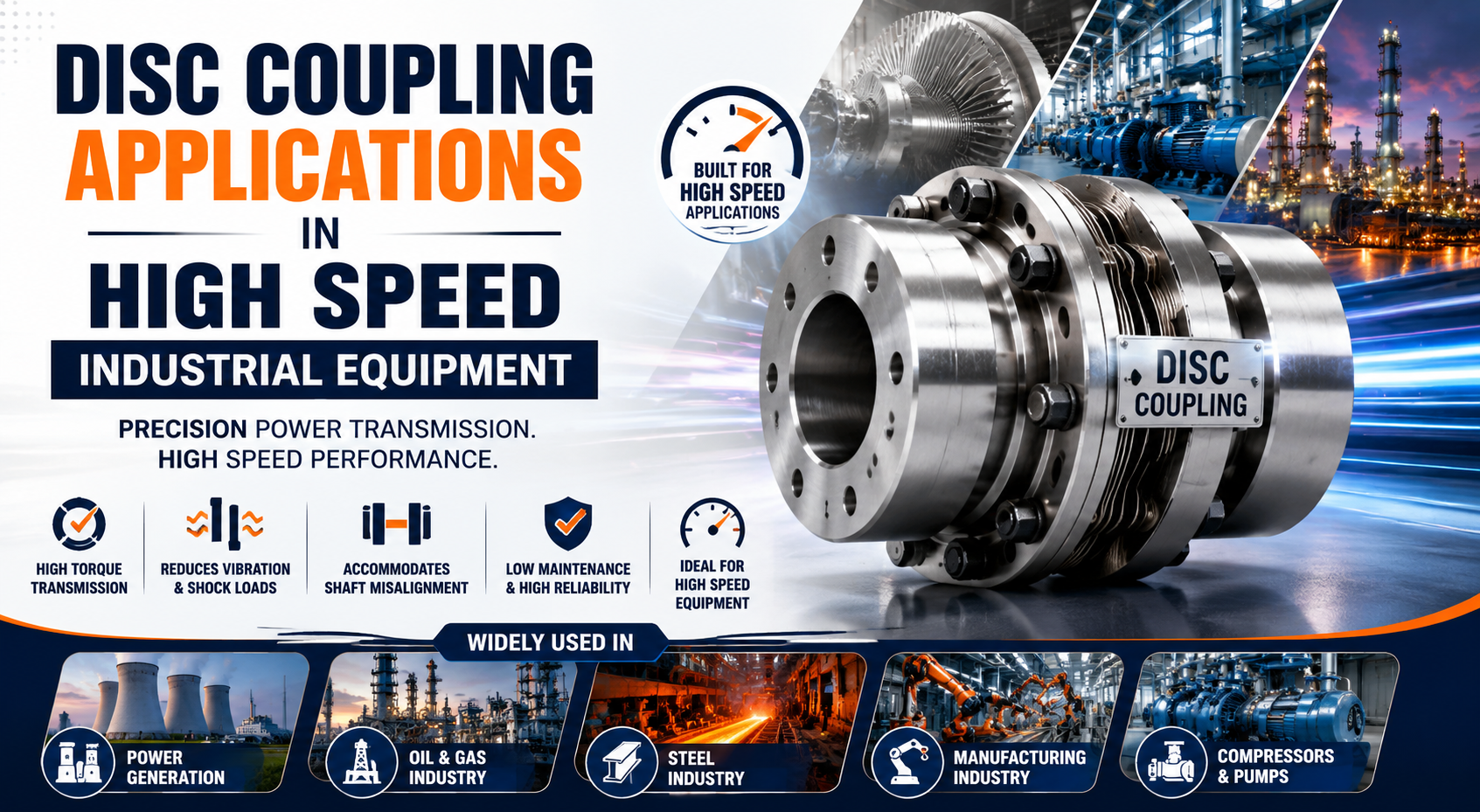
High speed industrial equipment requires precision, stability, and efficient power transmission to maintain smooth operations. Industries such as power generation, steel manufacturing, oil and gas processing, and automation systems rely on high performance machinery operating at high rotational speeds.
One of the most important components used in these systems is the Disc Coupling. Disc couplings are designed to transfer torque efficiently while handling shaft misalignment with minimal maintenance requirements.
To understand the complete fundamentals of industrial power transmission systems
What is a Disc Coupling?
A disc coupling is a flexible metallic coupling used to connect rotating shafts in industrial machinery. It uses thin metallic discs to transmit torque while compensating for shaft movement.
Disc couplings are widely preferred in high speed applications because they provide:
• high torsional stiffness
• low maintenance requirements
• zero backlash operation
• excellent torque transmission
• high speed performance
Disc couplings are commonly compared with Gear Coupling and Hydax Coupling solutions depending on industrial requirements.
Why Disc Couplings are Used in High Speed Equipment
High speed machinery requires stable components capable of handling demanding operational conditions.
Disc couplings provide several benefits:
Precision Torque Transmission
Disc couplings transfer power with high accuracy while minimizing power loss.
Benefits include:
• smooth operation
• stable power transfer
• reduced energy loss
• improved machine efficiency
Reduced Maintenance Requirements
Unlike some traditional couplings, disc couplings generally operate without lubrication requirements.
Advantages:
• lower maintenance costs
• reduced downtime
• improved operational reliability
Excellent Misalignment Compensation
Industrial machinery often experiences shaft movement because of temperature changes and operational conditions.
Disc couplings can compensate for:
• angular misalignment
• axial movement
• parallel misalignmentTo understand proper coupling selection,
Applications of Disc Couplings in High Speed Industrial Equipment
Disc couplings are used across various industries.
Power Generation Industry
Applications include:
• turbines
• compressors
• generators
Oil and Gas Industry
Applications include:
• pumps
• compressors
• processing equipment
Steel Industry
Applications include:
• rolling systems
• heavy machinery
• industrial drives
Manufacturing Industry
Applications include:
• automation systems
• high speed rotating equipment
• precision machinery
Disc Coupling vs Other Industrial Couplings
Disc couplings differ from traditional industrial couplings in several ways.
| Features | Disc Coupling | Gear Coupling | Hydax Coupling |
| Speed Performance | High | Moderate | Moderate |
| Maintenance | Low | Moderate | Low |
| Lubrication | No | Yes | Low |
| Misalignment Compensation | High | Moderate | Good |
| Precision | Excellent | Good | Good |
For detailed comparisons you can also explore Hydax Coupling vs Flexible Coupling for Power Transmission
Disc couplings help industries achieve:
• improved machinery performance
• reduced maintenance costs
• efficient power transmission
• longer equipment life
• reduced vibration
• better operational stability
Final Thoughts
Disc couplings are widely used in high speed industrial equipment because of their ability to provide precise torque transmission, handle shaft misalignment, and operate with minimal maintenance requirements.
Industries requiring reliable high speed performance often choose disc couplings because they improve efficiency while reducing operational costs.
FAQ
What is a disc coupling used for?
Disc couplings are used to transfer torque efficiently between rotating shafts in high speed industrial machinery.
Why are disc couplings preferred in high speed applications?
Disc couplings provide precise torque transmission, low maintenance requirements, and excellent shaft misalignment handling.
Which industries use disc couplings?
Disc couplings are commonly used in power plants, steel industries, oil and gas facilities, and manufacturing systems.
Do disc couplings require lubrication?
No, disc couplings generally operate without lubrication, reducing maintenance requirements.
Can disc couplings compensate for shaft misalignment?
Yes, disc couplings can handle angular, axial, and parallel shaft movement.
What are the main benefits of disc couplings?
Disc couplings provide high precision, lower maintenance costs, improved performance, and reliable power transmission.
How do disc couplings improve machinery life?
Disc couplings reduce vibration and stress on connected machinery components, helping increase equipment lifespan.


