
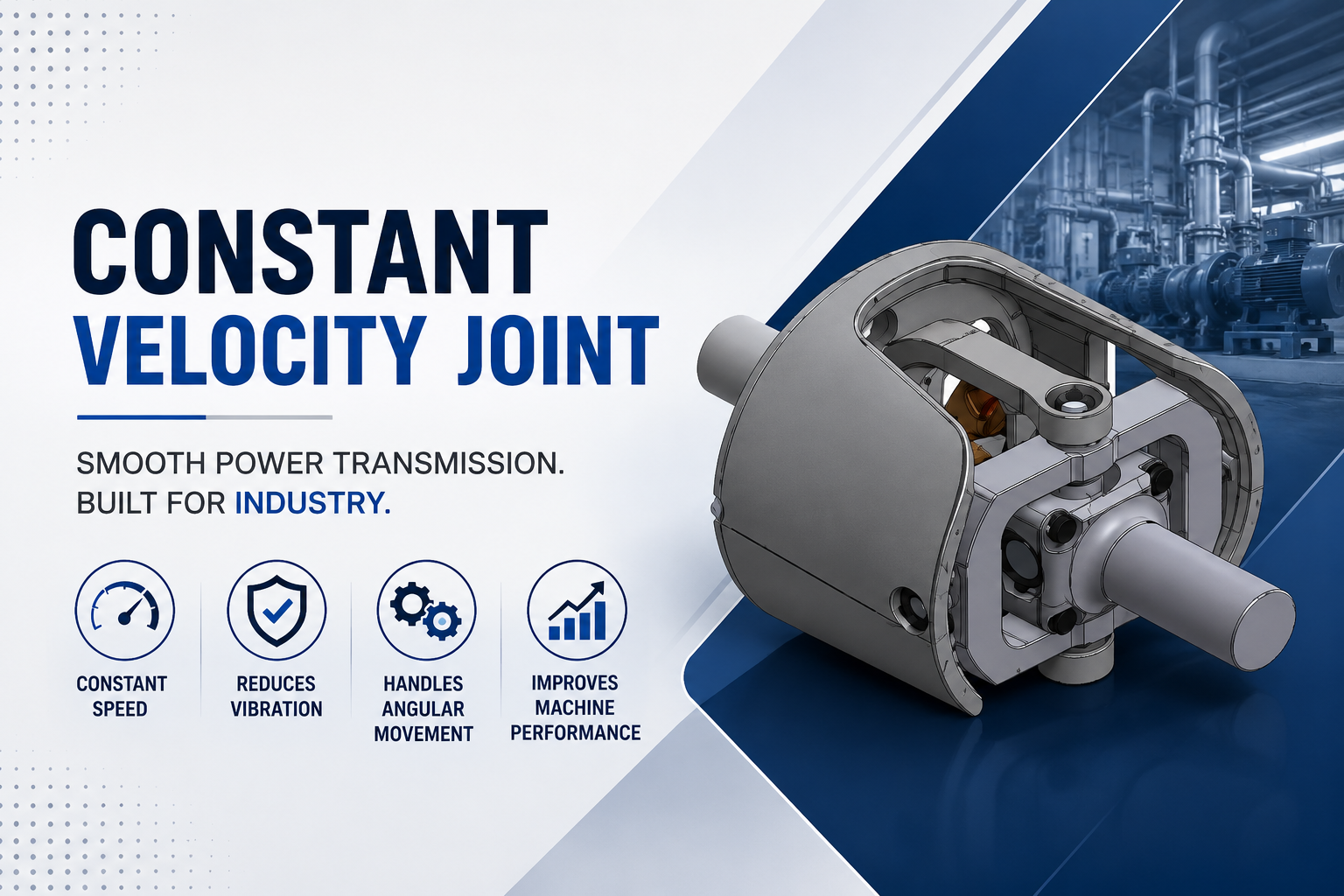
Industrial machinery depends on smooth and efficient power transmission for maintaining operational performance. In heavy industrial environments, machinery often operates under varying shaft angles, rotational speeds, and high torque conditions. Traditional coupling systems may face limitations when transmitting power under changing angles and continuous movement.
This is where a constant velocity joint becomes important. A constant velocity joint is designed to transfer rotational power smoothly while maintaining constant speed regardless of shaft angle changes.
What is a Constant Velocity Joint?
A Constant Velocity Joint, commonly known as a CV Joint, is a mechanical component used to transmit rotational movement between shafts while maintaining constant rotational speed even when operating at different angles.
Unlike traditional coupling systems, a constant velocity coupling ensures smooth motion transfer without significant speed variation.
These systems are designed to:
• maintain constant rotational speed
• reduce vibration
• improve torque transmission
• compensate for shaft movement
• improve machine efficiency
Industrial applications increasingly rely on industrial Constant Velocity Joint systems because they improve performance and reduce equipment wear.
How Does a Constant Velocity Joint Work?
A constant velocity joint transfers rotational power through specially designed internal components that allow movement while maintaining smooth speed transmission.
The working process includes:
• transmitting torque efficiently
• compensating for shaft angle changes
• reducing mechanical stress
• maintaining smooth rotational movement
For industries using high precision machinery, thompson constant velocity joint systems help improve equipment stability and performance.
Why Constant Velocity Joints are Important in Industry
Smooth Power Transmission
Industrial equipment requires stable torque transmission.
Benefits include:
• reduced vibration
• smoother machine operation
• lower energy loss
• improved equipment efficiency
Handles Angular Movement
Industrial systems often operate with shaft movement during operation.
Constant velocity joints help:
• compensate for shaft angle variations
• improve alignment performance
• reduce stress on components
Reduced Equipment Wear
Poor shaft movement handling can increase machine wear.
Benefits:
• lower maintenance requirements
• improved equipment life
• reduced downtime
For vibration reduction applications industries often compare Tyre Coupling, Disc Coupling, Jaw Coupling, Gear Coupling, and Hydax Coupling solutions depending on machine requirements.
Industrial Applications of Constant Velocity Joints
Constant velocity joints are commonly used in:
Manufacturing Industry
Applications include:
• automation systems
• rotating equipment
• conveyor systems
Power Industry
Applications include:
• turbines
• compressors
• pumps
Heavy Machinery Industry
Applications include:
• mining equipment
• industrial drives
• material handling systems
Final Thoughts
Constant velocity joints play a critical role in modern industrial power transmission systems. Their ability to maintain constant rotational speed while handling movement and varying angles improves machine reliability and performance.
Industries requiring precision operation and stable torque transmission often use industrial cv joint systems because of their long term operational benefits.
FAQ
What is a constant velocity joint used for?
Constant velocity joints are used to transfer rotational power while maintaining constant speed between connected shafts.
What is a Thompson Constant Velocity Joint?
A Thompson Constant Velocity Joint is a high performance mechanical joint designed to transmit power efficiently at varying shaft angles.
What are the benefits of an industrial CV joint?
Industrial CV joints provide smoother torque transmission, lower vibration, improved equipment life, and reduced maintenance.
Which industries commonly use constant velocity joints?
Constant velocity joints are commonly used in manufacturing, mining, automotive, power generation, and heavy machinery industries.
How does a constant velocity coupling improve machinery performance?
Constant velocity couplings improve machine efficiency by reducing vibration and maintaining smooth power transfer.
Can constant velocity joints reduce equipment wear?
Yes, they reduce stress on machine components and help increase equipment lifespan.
What is the difference between a CV joint and traditional coupling?
CV joints maintain constant rotational speed at varying angles while traditional couplings may experience speed variation.


