
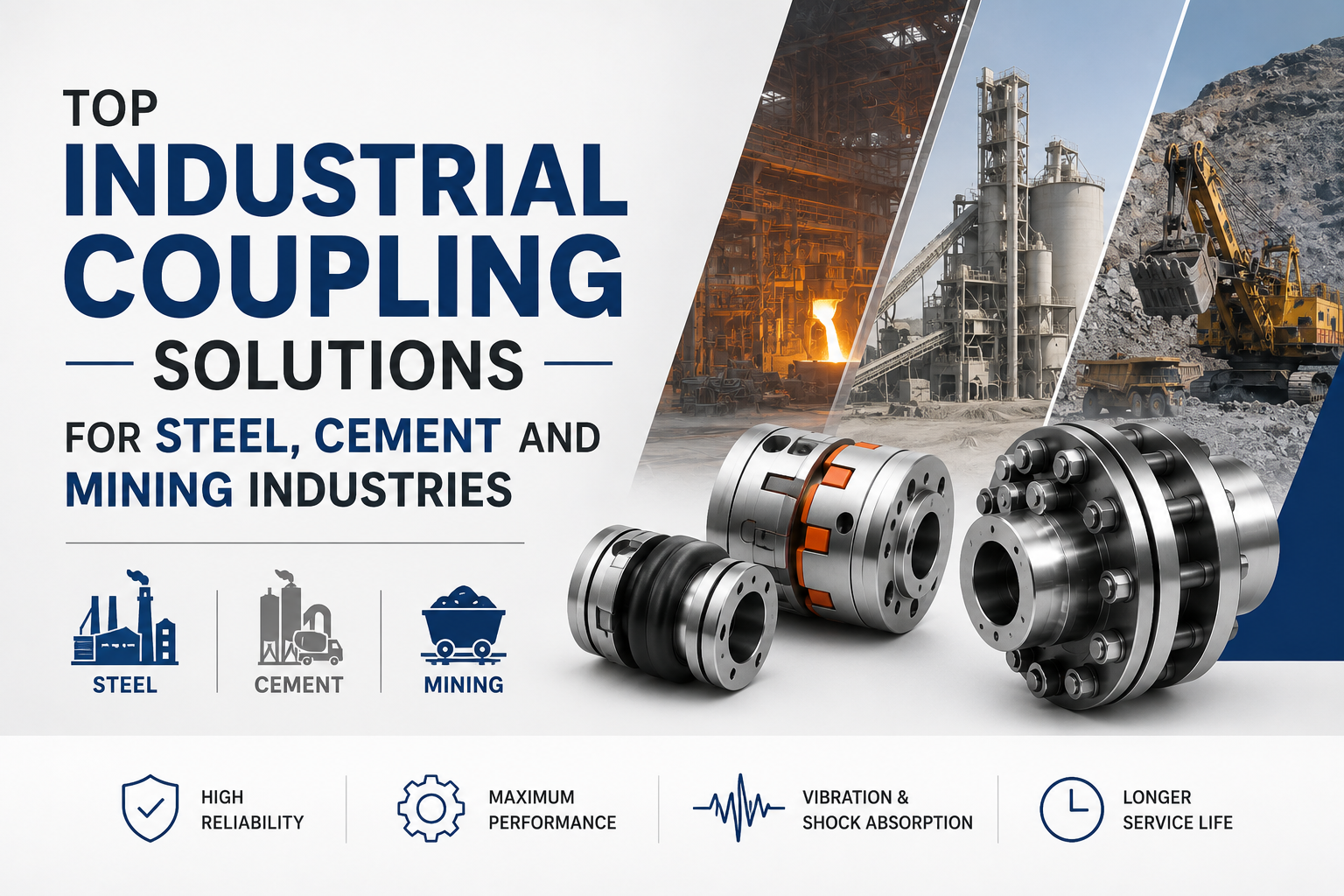
Heavy industries such as steel manufacturing, cement production, and mining operations depend on powerful machinery for continuous production and smooth operations. Equipment used in these industries works under high loads, extreme temperatures, dust exposure, and constant vibration. Because of these demanding conditions, selecting the right industrial coupling solution becomes important for improving efficiency and reducing equipment failure.
Industrial couplings play a critical role in transferring torque between connected shafts while reducing vibration, handling misalignment, and protecting machinery from excessive stress. Different industries require different coupling solutions depending on operating conditions and machinery requirements.
If you are planning industrial machinery upgrades, you can also read our [Complete Guide to Industrial Couplings and Power Transmission Systems] and [How to Choose the Right Industrial Coupling for Heavy Machinery] for a deeper understanding of coupling selection and industrial applications.
Why Industrial Couplings Matter in Heavy Industries
Heavy machinery often operates for long hours under harsh environments. Small alignment issues or vibration can create larger mechanical problems over time.
Industrial coupling solutions help:
- improve power transmission efficiency
- reduce vibration
- absorb shock loads
- reduce maintenance costs
- increase machine life
- minimize unexpected downtime
Choosing the correct coupling helps industries maintain stable operations and improve overall productivity.
Industrial Coupling Solutions for Steel Industry
Steel plants operate under some of the toughest industrial conditions. Rolling mills, conveyors, blast furnaces, and processing equipment require heavy duty coupling systems capable of handling high torque and continuous operation.
Recommended Couplings for Steel Industry
Gear Couplings
Gear couplings are widely used in steel plants because of their strength and ability to handle heavy loads.
Benefits:
- high torque transmission
- suitable for heavy duty machinery
- long service life
- handles difficult operating conditions
Applications:
- rolling mills
- conveyor systems
- steel processing equipment
You can also explore our Gear Coupling Solutions page for more details.
Grid Couplings
Grid couplings provide vibration damping and shock load absorption for heavy industrial systems.
Applications:
- industrial pumps
- crushers
- motors
- conveyors
Benefits:
- reduced vibration
- equipment protection
- improved machinery performance
Industrial Coupling Solutions for Cement Industry
Cement plants require machinery capable of operating under dusty and high load conditions. Equipment such as crushers, rotary kilns, mills, and conveyors runs continuously and requires reliable coupling systems.
Recommended Couplings for Cement Industry
Tyre Couplings
Tyre couplings are flexible coupling solutions commonly used in cement plants.
Benefits:
- absorbs shock loads
- handles shaft misalignment
- reduces vibration
- easy maintenance
Applications:
- conveyor systems
- industrial drives
- rotary equipment
Pin Bush Couplings
Pin bush couplings are widely used because they can handle fluctuating loads efficiently.
Benefits:
- smooth operation
- flexible design
- lower maintenance requirements
Applications:
- mixers
- crushers
- material handling systems
Industrial Coupling Solutions for Mining Industry
Mining operations involve extreme conditions including heavy loads, dust, vibration, and continuous equipment movement. Mining equipment requires strong and reliable coupling solutions.
Recommended Couplings for Mining Industry
Grid Couplings
Grid couplings are highly preferred in mining operations because of their shock absorbing capabilities.
Applications:
- crushers
- conveyors
- material handling systems
Benefits:
- absorbs vibration
- reduces stress on equipment
- improves machinery life
Gear Couplings
Gear couplings are commonly used for heavy torque transmission in mining systems.
Applications:
- mining conveyors
- drilling equipment
- crushers
Benefits:
- high strength
- reliable torque transmission
- suitable for heavy duty applications
You can also explore our Industrial Coupling Selection Guide for selecting the right coupling for specific applications.
Key Factors When Selecting Industrial Couplings
Before choosing a coupling solution, industries should consider:
Torque Requirements
Heavy industries require couplings capable of handling continuous and peak loads.
Shaft Misalignment
Machines often experience angular and parallel shaft movement.
Operating Environment
Conditions such as dust, heat, moisture, and vibration should be considered.
Maintenance Requirements
Low maintenance coupling systems help reduce operational downtime.
Machine Speed
Different machinery requires different coupling designs for effective operation.
Final Thoughts
Steel, cement, and mining industries require reliable industrial coupling systems for smooth operations and long term machinery performance. Choosing the right coupling solution helps improve efficiency, reduce downtime, and protect machinery from damage.
Gear couplings, grid couplings, tyre couplings, and pin bush couplings each provide specific benefits depending on industrial applications and operating conditions.
Understanding machinery requirements and selecting the right coupling solution can significantly improve operational efficiency and equipment lifespan.
FAQ Section
1. Which coupling is best for steel industry applications?
Gear couplings are commonly used in steel plants because they can handle high torque and demanding operating conditions.
2. Why are grid couplings used in mining industries?
Grid couplings help absorb vibration and shock loads, making them suitable for mining equipment and heavy machinery.
3. What type of coupling is suitable for cement plants?
Tyre couplings and pin bush couplings are commonly used in cement plants because they provide flexibility and vibration reduction.
4. How do industrial couplings improve machinery performance?
Industrial couplings improve torque transmission, reduce vibration, minimize machine stress, and increase equipment life.
5. What factors should be considered while selecting industrial couplings?
Important factors include torque capacity, operating environment, shaft alignment, maintenance requirements, and machine speed.
6. Which industries use heavy duty industrial couplings?
Steel, cement, mining, power generation, oil and gas, and manufacturing industries commonly use heavy duty industrial couplings.
7. How do industrial couplings reduce downtime?
Industrial couplings reduce wear and tear, improve equipment stability, and minimize machine failures, reducing maintenance and downtime.


