
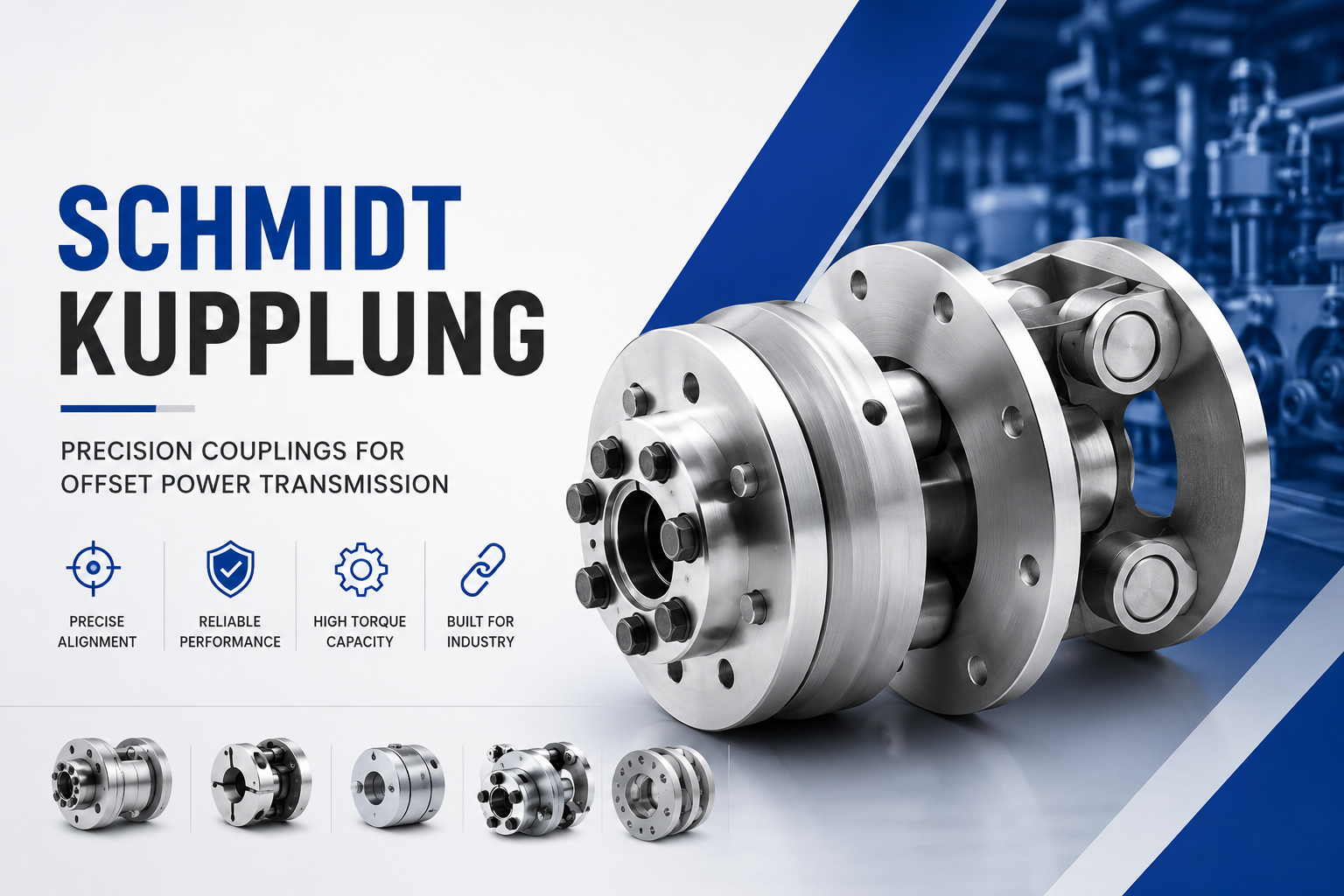
In industrial machinery, shaft alignment plays a critical role in ensuring smooth power transmission and equipment reliability. Even a small offset between rotating shafts can create vibration, increase wear on bearings, and reduce machine efficiency. This is where Schmidt Kupplung technology becomes valuable.
A Schmidt Kupplung is a specialized coupling designed to transmit torque between parallel shafts that are intentionally offset from one another. Unlike conventional couplings that primarily compensate for minor misalignment, Schmidt couplings are engineered to handle significant parallel shaft offsets while maintaining constant rotational speed and smooth power transmission.
Because of this unique capability, Schmidt couplings are widely used in industries where machinery design requires offset shaft arrangements without compromising performance.
Understanding Schmidt Kupplung Technology
The Schmidt coupling was developed to solve a common engineering challenge: transmitting rotational power between shafts that are parallel but not positioned on the same centerline.
Traditional coupling systems often struggle when larger offsets are involved. Excessive shaft movement can lead to vibration, mechanical stress, and premature component failure. Schmidt couplings eliminate these issues by allowing precise torque transmission across offset shafts while maintaining synchronized rotation.
One of the most advanced solutions available today is the Schmidt-Kupplung Offset Plus V, which is designed for demanding industrial environments where reliability and precision are essential.
The design allows machinery manufacturers greater flexibility when developing compact equipment layouts, automation systems, and specialized industrial machinery.
How Does a Schmidt Kupplung Work?
A Schmidt coupling uses a system of interconnected links and discs that transfer rotational motion from the driving shaft to the driven shaft.
As the shafts rotate, the coupling compensates for the offset while maintaining constant angular velocity. This means the output shaft rotates smoothly without speed fluctuations.
The result is:
• stable torque transmission
• reduced vibration
• improved shaft synchronization
• lower mechanical stress
• increased equipment reliability
This capability makes Schmidt couplings particularly useful in high precision industrial applications where smooth operation is critical.
Key Benefits of Schmidt Kupplung
Handles Large Parallel Shaft Offsets
The biggest advantage of a Schmidt coupling is its ability to work with significant shaft offsets that would be difficult for conventional couplings to accommodate.
Smooth Power Transmission
The coupling maintains constant rotational speed, helping machinery operate more efficiently.
Reduced Maintenance Requirements
Lower vibration and reduced stress on connected components often result in longer equipment life and fewer maintenance interventions.
Compact Machine Design
Machine builders can design equipment with more flexibility because shafts do not need to be perfectly aligned on the same centerline.
Where is Schmidt Kupplung Used in Industry?
Schmidt couplings are commonly used across several industries where offset shaft arrangements are required.
Printing Industry
Printing machines require highly synchronized movement between rollers and drive systems. Schmidt couplings help maintain precise rotational control.
Packaging Machinery
Packaging equipment often contains complex layouts where shaft offsets are unavoidable. Schmidt couplings ensure smooth and reliable operation.
Automation Systems
Industrial automation equipment benefits from the coupling’s ability to handle offset shafts while maintaining accuracy and repeatability.
Textile Industry
Textile machinery operates continuously for long periods. Schmidt couplings help reduce vibration and improve operational stability.
Special Purpose Machinery
Many custom built industrial machines use Schmidt-Kupplung Offset Plus V solutions to overcome design constraints while maintaining performance.
Schmidt Kupplung vs Other Industrial Couplings
Every industrial coupling serves a different purpose.
A Disc Coupling is commonly selected for high speed applications where precision and torsional stiffness are important.
A Jaw Coupling is often used when vibration damping and shock load absorption are required.
A Gear Coupling is preferred for heavy duty applications involving high torque transmission and demanding operating conditions.
A Schmidt coupling, however, stands out when parallel shaft offset compensation is the primary requirement.
Final Thoughts
Schmidt Kupplung technology provides an effective solution for one of the most challenging problems in industrial power transmission: connecting offset shafts while maintaining smooth and accurate rotation.
Its ability to compensate for large parallel offsets, reduce vibration, and improve machinery reliability makes it a valuable component in modern industrial systems. Whether used in packaging equipment, automation machinery, printing systems, or specialized industrial applications, Schmidt couplings continue to offer engineers greater flexibility and dependable performance.
For industries requiring precise shaft synchronization and efficient power transmission, Schmidt couplings remain one of the most practical and innovative solutions available today.


