
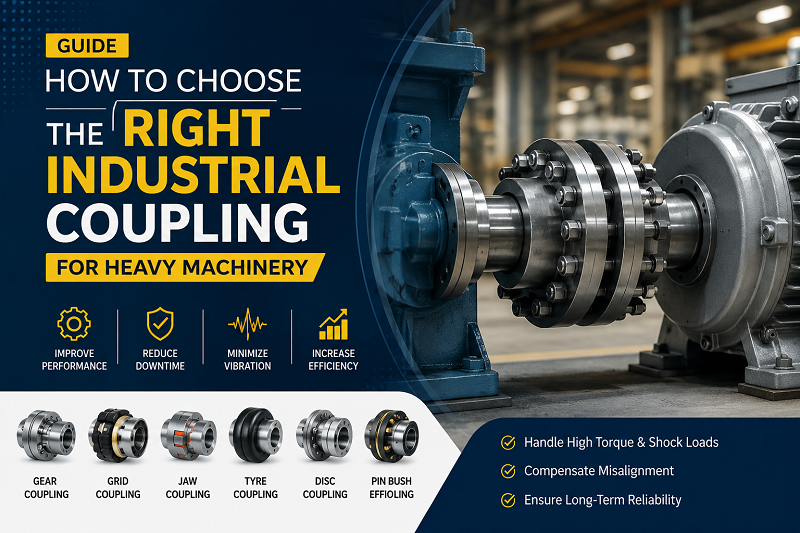
In heavy industries, even the smallest mechanical component can influence the performance of an entire production line. Industrial couplings are one such critical element. They connect rotating shafts, transmit torque, compensate for misalignment, reduce vibration, and protect machinery from operational stress. Selecting the right industrial coupling is not simply a technical decision. It directly impacts equipment reliability, maintenance costs, productivity, and operational efficiency.
From cement plants and steel mills to mining operations and power generation facilities, every industrial setup requires a coupling solution that can withstand demanding conditions. Understanding how to choose the right coupling for heavy machinery can help industries improve machine life and reduce costly downtime.
Understanding the Role of Industrial Couplings
Industrial couplings are mechanical devices designed to connect two shafts for power transmission. Their primary function is to transfer torque from one rotating component to another while accommodating certain operational variations such as shaft misalignment, vibration, shock loads, and thermal expansion.
Heavy machinery often operates under extreme conditions involving high torque, fluctuating loads, dust, heat, and continuous movement. Without the right coupling, machinery can experience premature wear, shaft failure, excessive vibration, or breakdowns that interrupt production.
Choosing the correct coupling ensures smoother power transmission, better alignment management, and increased operational stability.
Key Factors to Consider When Choosing an Industrial Coupling
1. Torque Requirements
Torque is one of the most important factors in coupling selection. Every machine generates a specific amount of rotational force that the coupling must handle safely.
For heavy machinery applications such as crushers, conveyors, rolling mills, and compressors, the coupling should be capable of handling:
- continuous torque
- peak torque
- shock loads
- startup loads
Undersized couplings may fail under pressure, while oversized couplings can reduce system efficiency and increase costs unnecessarily.
Industries commonly use gear couplings, grid couplings, and disc couplings for high torque applications because of their durability and load handling capability.
2. Shaft Misalignment
Perfect shaft alignment is difficult to maintain in industrial environments. Machines often experience:
- angular misalignment
- parallel misalignment
- axial movement
The right coupling should compensate for these variations without placing excessive stress on bearings and shafts.
Flexible couplings such as jaw couplings, tyre couplings, and pin bush couplings are widely used because they can absorb misalignment while maintaining efficient torque transmission.
In applications with significant offset movement, Schmidt couplings and alignment eliminator couplings provide excellent performance.
3. Operating Environment
Industrial environments can be extremely harsh. Before selecting a coupling, it is essential to evaluate the surrounding conditions.
Consider factors such as:
- high temperatures
- moisture exposure
- chemical contamination
- dust and debris
- vibration intensity
- outdoor conditions
For mining and cement industries where dust and shock loads are common, grid couplings are often preferred due to their robust construction and vibration damping capabilities.
For corrosive or high temperature environments, metallic disc couplings may offer better durability and reliability.
4. Speed and Performance Requirements
Different industrial applications operate at different rotational speeds. High speed applications require couplings with excellent balance and precision.
Disc couplings are commonly used in turbines, pumps, and compressors because they offer:
- high torsional stiffness
- zero backlash
- low maintenance
- high speed capability
For lower-speed heavy load applications, gear couplings and pin bush couplings are more suitable due to their shock absorbing characteristics.
5. Vibration and Shock Load Absorption
Heavy machinery often generates vibration and sudden impact loads during operation. Excessive vibration can damage equipment and reduce machine life.
Flexible couplings help absorb these forces and improve operational stability.
Tyre couplings and grid couplings are highly effective in:
- reducing vibration
- absorbing shock loads
- minimizing mechanical stress
This makes them ideal for conveyors, crushers, mixers, and heavy duty industrial systems.
6. Maintenance Requirements
Maintenance accessibility is another critical consideration when selecting industrial couplings. Some coupling types require regular lubrication and inspection, while others are designed for minimal maintenance.
For industries aiming to reduce downtime and operational interruptions, maintenance free or low maintenance couplings are often preferred.
Disc couplings and jaw couplings are popular because they offer reliable performance with relatively low maintenance requirements.
Gear couplings, while extremely strong, may require periodic lubrication for long term efficiency.
Common Types of Industrial Couplings
Gear Couplings
Gear couplings are ideal for high torque applications and heavy industrial machinery. They are commonly used in steel plants, mining operations, and cement industries.
Grid Couplings
Grid couplings provide excellent shock absorption and vibration damping. They are widely used in conveyor systems and heavy duty rotating equipment.
Jaw Couplings
Jaw couplings are flexible and suitable for moderate torque applications. They help reduce vibration and are commonly used in pumps and compressors.
Disc Couplings
Disc couplings are designed for high speed precision applications. They provide accurate torque transmission with minimal backlash.
Tyre Couplings
Tyre couplings use flexible rubber elements to absorb shock loads and accommodate misalignment effectively.
Pin Bush Couplings
Pin bush couplings are durable and economical solutions for heavy machinery operating under fluctuating loads.
Industry Specific Coupling Selection
Different industries require different coupling solutions based on operational demands.
Cement Industry
Cement plants require couplings capable of handling dust, heavy loads, and continuous operation. Gear couplings and grid couplings are commonly used.
Steel Industry
Steel plants operate under high torque and extreme temperatures. Heavy duty gear couplings are preferred for rolling mills and processing equipment.
Mining Industry
Mining applications demand shock resistant and vibration absorbing couplings. Grid couplings and tyre couplings perform effectively in these environments.
Power Plants
Power generation systems often use disc couplings for turbines and compressors due to their precision and high speed capabilities.
Final Thoughts
Choosing the right industrial coupling is essential for ensuring long term machinery performance, operational reliability, and reduced maintenance costs. Every application has unique requirements, and selecting the correct coupling depends on torque capacity, alignment conditions, environmental factors, speed, vibration control, and maintenance expectations.
A properly selected coupling not only improves power transmission efficiency but also protects expensive industrial equipment from unnecessary wear and failure. Industries investing in the right coupling solutions can achieve better productivity, lower downtime, and improved operational safety.
As industrial systems continue evolving toward higher efficiency and automation, the demand for advanced and reliable coupling solutions will continue to grow. Understanding the fundamentals of coupling selection is the first step toward building a stronger and more efficient industrial operation.
Frequently Asked Questions
What is an industrial coupling?
An industrial coupling is a mechanical component used to connect two rotating shafts for transmitting torque and power while compensating for misalignment, vibration, and shock loads in industrial machinery.
Why is choosing the right coupling important for heavy machinery?
Choosing the right coupling improves machinery performance, reduces downtime, minimizes vibration, protects equipment from damage, and ensures efficient power transmission in heavy industrial applications.
Which coupling is best for high torque industrial applications?
Gear couplings and grid couplings are commonly preferred for high torque industrial applications because of their strength, durability, and ability to handle heavy loads and shock conditions.
What factors should be considered when selecting an industrial coupling?
Important factors include torque capacity, shaft misalignment, operating speed, environmental conditions, vibration levels, maintenance requirements, and the type of industrial application.
Which coupling is suitable for vibration and shock absorption?
Tyre couplings, jaw couplings, and grid couplings are highly effective for vibration damping and shock load absorption in heavy machinery applications.
What industries commonly use industrial couplings?
Industrial couplings are widely used in steel plants, cement industries, mining operations, power plants, paper mills, oil and gas facilities, and manufacturing industries.
How do flexible couplings improve industrial machinery performance?
Flexible couplings help accommodate shaft misalignment, reduce vibration, absorb shock loads, and improve the overall efficiency and lifespan of industrial machinery.


