
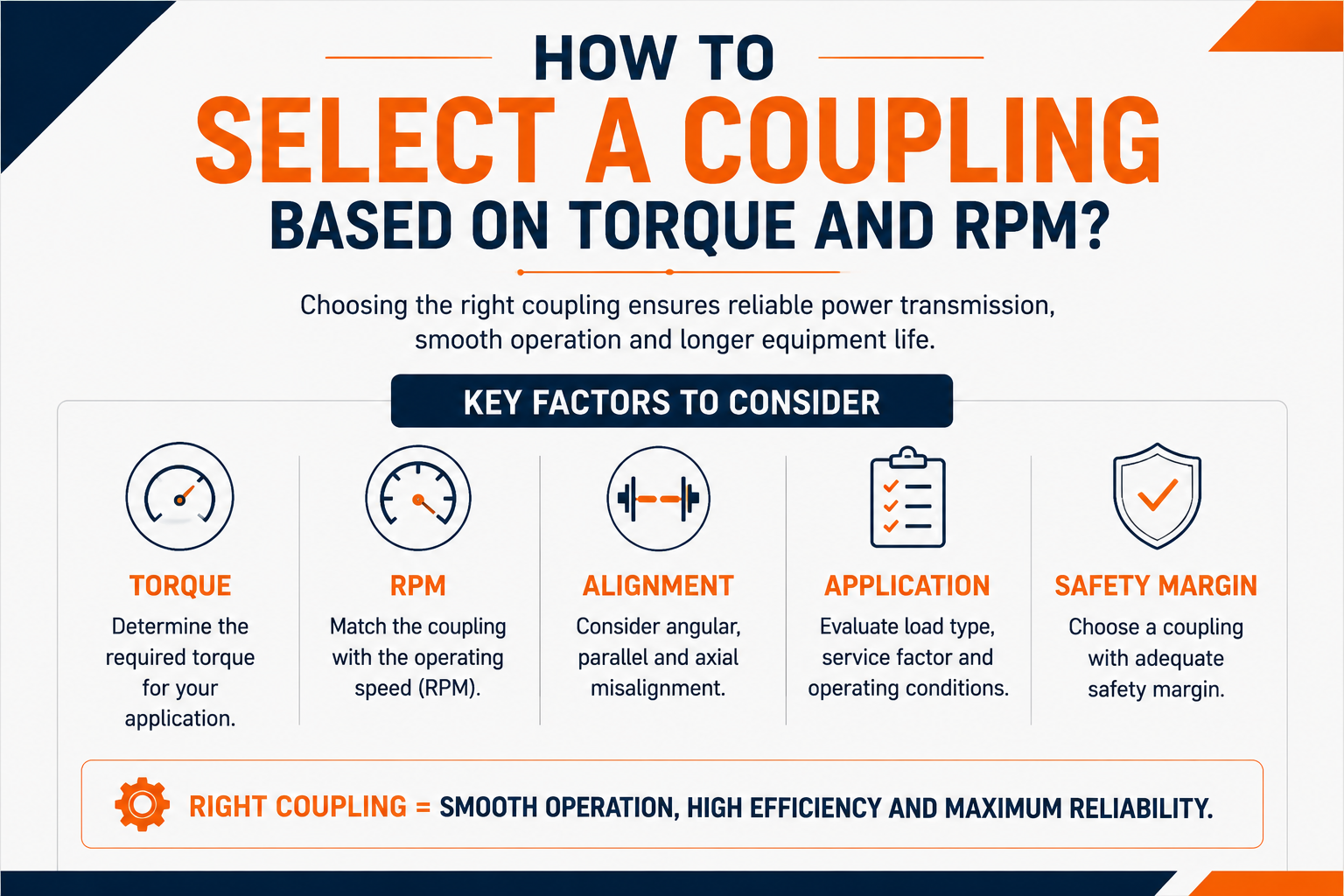
Two of the most important factors in coupling selection are torque and RPM. A coupling that is suitable for a low speed, high torque application may not be suitable for a high speed rotating machine. Incorrect selection can lead to vibration, premature wear, bearing problems, coupling failure, and unexpected equipment downtime.
This guide explains how to select an industrial coupling based on torque and RPM and what other factors should be considered before making a final decision.
Why Torque and RPM Matter in Coupling Selection
Torque represents the rotational force transmitted through the coupling, while RPM represents the rotational speed of the shaft.
Both factors directly influence the type and size of coupling required.
A conveyor operating at a relatively low speed may generate high torque, especially during starting or under heavy loads. On the other hand, a compressor or turbine may operate at very high RPM and require a coupling with appropriate balancing and dynamic performance.
The objective is to select a coupling that can safely handle the required torque while operating reliably at the intended speed.
Understanding the Relationship Between Power, Torque and RPM
Power, torque, and speed are closely connected.
A commonly used engineering relationship is:
Torque Nm = 9550 × Power kW ÷ RPM
This calculation provides a starting point for determining the torque requirement of a rotating system.
For example, as rotational speed decreases for the same power output, torque increases. This is why low speed equipment such as crushers, conveyors, mills, and heavy duty process equipment may require couplings with higher torque capacity.
However, the calculated torque should not be the only factor used for selection.
Rated Torque Is Not Always the Actual Operating Requirement
Industrial equipment can experience torque peaks during:
- Motor starting
- Sudden loading
- Material blockage
- Direction changes
- Shock loading
- Frequent starts and stops
For this reason, coupling selection should consider the complete operating profile rather than only the normal running torque.
A suitable service factor may be required depending on the equipment and application conditions.
How RPM Affects Industrial Coupling Selection
RPM is equally important because increasing rotational speed creates additional mechanical and dynamic considerations.
At higher speeds, factors such as balance, vibration, centrifugal forces, and shaft alignment become increasingly important.
High Speed Applications
High speed machinery may include:
- Compressors
- Turbines
- Pumps
- Blowers
- Test equipment
- High speed process machinery
The coupling must be selected according to its permitted operating speed and the requirements of the complete rotating system.
Balance and Dynamic Performance
At higher RPM, even relatively small imbalances can contribute to vibration.
The coupling should therefore be appropriate for the required rotational speed and operating conditions. Proper installation and shaft alignment also become critical for reliable performance.
Misalignment at High RPM
Misalignment can create additional forces and vibration in rotating equipment.
The selected coupling should accommodate the expected angular, parallel, or axial shaft movement within its specified operating capability.
Selecting a Coupling for High Torque Applications
High torque applications require particular attention because the coupling must transmit significant rotational force without exceeding its rated capacity.
Typical high torque applications include:
- Crushers
- Rolling mills
- Mining equipment
- Sugar mills
- Heavy conveyors
- Mixers and agitators
- Gearboxes
- Material handling systems
Different coupling designs may be considered depending on the application.
Gear Couplings for Heavy Torque Transmission
Gear couplings are commonly used in demanding industrial applications where high torque transmission is required.
They can be found in equipment operating in industries such as steel, mining, cement, and heavy material handling.
The final selection should consider torque capacity, speed, shaft dimensions, alignment requirements, and operating conditions.
Flexible Couplings for Shock and Vibration
Flexible coupling designs can help accommodate specified shaft movement while supporting smooth torque transmission.
Depending on the design and application, they may also help manage vibration and changing loads within the drive system.
This makes proper coupling selection particularly important in equipment where operating conditions are not constant.
Where Does the TB Woods Sure Flex Coupling Fit?
The TB Woods Sure Flex Coupling is a flexible coupling solution commonly considered for industrial power transmission applications where a combination of torque transmission and flexibility is required.
The appropriate selection depends on factors such as:
- Required torque
- Operating RPM
- Motor power
- Shaft sizes
- Equipment type
- Starting conditions
- Expected misalignment
- Operating environment
Why Application Data Is Important
A coupling should never be selected based only on its physical size or general appearance.
Two machines may use similar motor power but require completely different coupling capacities because their torque, RPM, duty cycle, and load characteristics are different.
A detailed application review helps identify a suitable coupling configuration for the complete drive system.
Important Factors Beyond Torque and RPM
Although torque and RPM are the primary starting points, several additional factors influence industrial coupling selection.
1. Service Factor
The service factor accounts for the severity of the application.
Equipment operating continuously under demanding loads may require a different selection approach compared with equipment running under stable conditions.
2. Shaft Size and Arrangement
The coupling must be compatible with the shaft dimensions and the physical arrangement of the connected equipment.
Available installation space should also be considered.
3. Type of Misalignment
Different equipment can experience:
- Angular misalignment
- Parallel offset
- Axial movement
The coupling should be selected according to the type and expected level of shaft movement.
For applications involving significant parallel offset requirements, specialised solutions such as Schmidt Kupplung products may be considered depending on the machine configuration.
4. Shock Loads
Applications such as crushers, conveyors, and heavy processing equipment can experience sudden changes in load.
The coupling should be evaluated for the expected operating and peak load conditions.
5. Operating Environment
Temperature, dust, moisture, chemicals, and other environmental conditions can affect coupling performance and maintenance requirements.
Industrial plants should consider the complete operating environment before finalising the coupling solution.
Common Mistakes in Torque and RPM Based Coupling Selection
Incorrect coupling selection can create operational issues that may affect the entire rotating system.
Selecting Only by Motor Power
Motor power alone does not provide the complete picture.
The same motor power can produce different torque requirements at different RPM levels.
Ignoring Starting Torque
Some equipment experiences significantly higher torque during startup.
This should be considered when evaluating the coupling capacity.
Overlooking Shaft Misalignment
A coupling may have sufficient torque capacity but still perform poorly if it is not suitable for the actual alignment conditions.
Choosing a Coupling Without Checking Maximum RPM
Every coupling application should be evaluated according to the required operating speed.
This is especially important for compressors, turbines, and other high speed rotating equipment.
Ignoring the Complete Drive Train
The coupling operates as part of a larger mechanical system.
Motors, gearboxes, pumps, bearings, driven equipment, and shaft arrangements all influence the final selection.
When Special Coupling Solutions May Be Required
Some applications have unusual shaft arrangements or significant offset requirements that cannot be addressed by a standard coupling selection.
In these situations, specialised technologies such as an Alignment Eliminator may be relevant depending on the mechanical configuration and application requirements.
The key point is that coupling selection should be based on actual engineering requirements rather than simply choosing the most commonly used coupling type.
Working with Industrial Coupling Distributors
Reliable product availability and technical support can be important when selecting replacement or application specific couplings.
Working with experienced Industrial Coupling Distributors can help businesses identify suitable coupling options based on application data such as torque, RPM, shaft size, and operating conditions.
Providing the following information can make the selection process more efficient:
- Motor power
- Operating RPM
- Required torque
- Equipment type
- Shaft diameter
- Shaft arrangement
- Type of load
- Starting frequency
- Expected misalignment
- Operating environment
This information creates a stronger foundation for selecting the right coupling solution.
Final Thoughts on Coupling Selection Based on Torque and RPM
Torque and RPM should be the starting point of every industrial coupling selection process.
High torque applications may require robust coupling designs capable of handling demanding loads, while high speed applications require careful consideration of operating speed, balance, vibration, and alignment.
However, the best selection strategy goes beyond checking one specification. Service factor, peak loads, shaft arrangement, misalignment, operating environment, and maintenance requirements should all be evaluated as part of the complete application.
Whether the requirement involves a flexible solution such as a TB Woods Sure Flex Coupling or another industrial coupling design, the final choice should always match the actual operating requirements of the equipment.
A properly selected coupling can support reliable torque transmission, smoother operation, and improved long term performance across the complete rotating system.


