
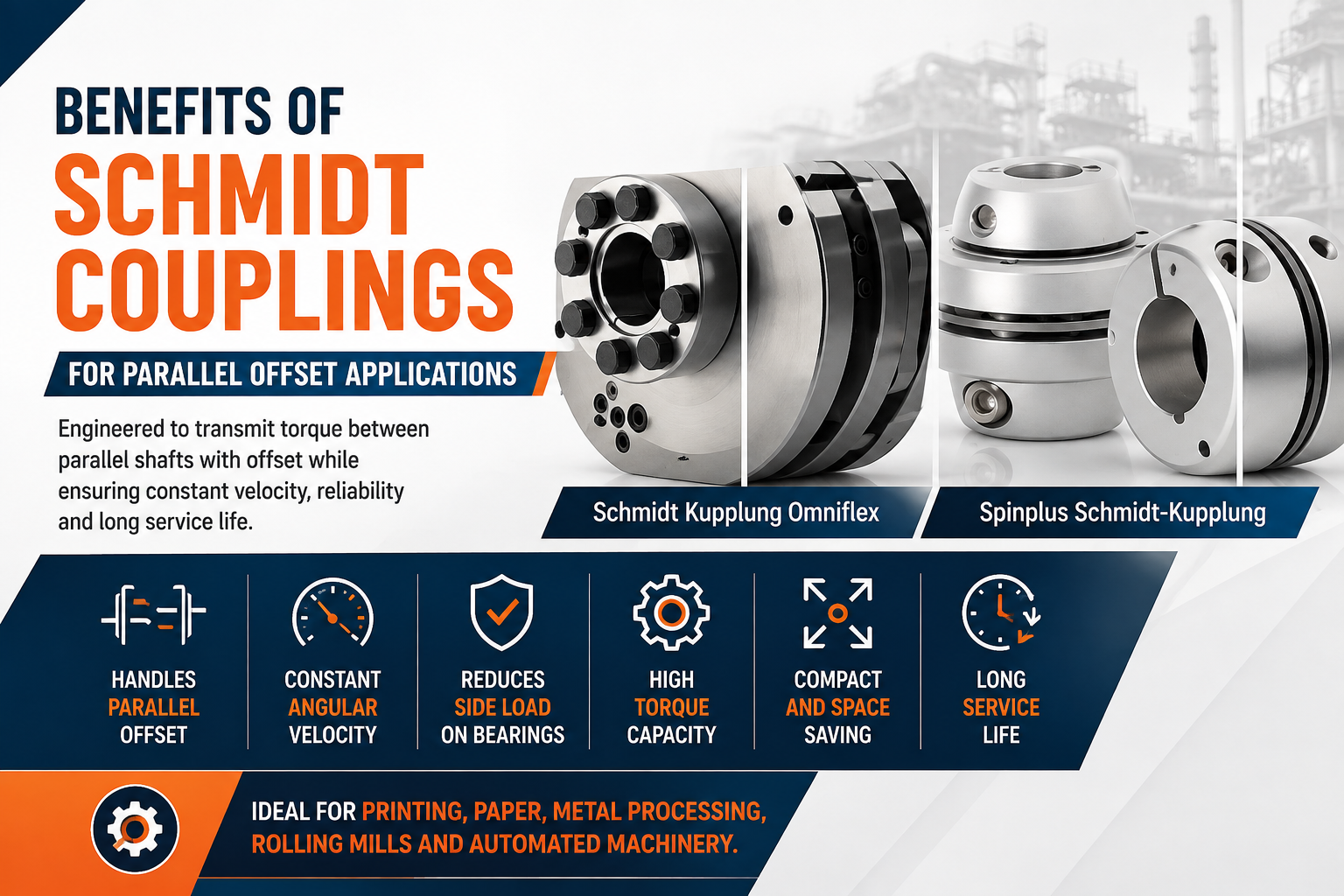
When two shafts need to transmit power while remaining parallel but physically offset, coupling selection becomes more complicated than simply choosing a standard flexible coupling. This situation is common in machinery where rollers, processing units, or other components change position during operation.
A Schmidt Coupling is designed specifically for this type of application. It allows torque transmission between parallel shafts while accommodating radial displacement and maintaining synchronised rotation.
For engineers evaluating parallel offset couplings, understanding where Schmidt technology fits can help avoid unnecessary mechanical complexity and improve machine reliability.
Understanding Parallel Shaft Offset
Parallel offset occurs when two connected shafts remain parallel but their centre lines are separated.
Why Does Parallel Offset Occur?
Parallel shaft displacement can result from:
Moving Machine Components
Rollers or processing components may move during operation, changing the distance between connected shafts.
Machine Design Requirements
Some equipment is intentionally designed with shafts positioned at different centre heights or distances.
Limited Installation Space
A conventional shaft arrangement may not be practical where machinery has restricted space.
Dynamic Operating Conditions
Thermal expansion, movement, or changes in machine geometry can alter shaft positions.
These situations require a coupling capable of handling the required movement without placing unnecessary loads on connected components.
What Is a Schmidt Coupling?
A Schmidt Coupling is a specialised coupling designed to transmit torque between parallel shafts while accommodating radial displacement.
How Does a Schmidt Coupling Work?
The coupling uses interconnected mechanical elements that allow the shafts to move relative to one another while maintaining their rotational relationship.
Constant Angular Velocity
One of the key characteristics of this coupling technology is its ability to maintain synchronised rotational speed between the input and output shafts while the parallel offset changes.
Controlled Radial Movement
Instead of simply resisting shaft displacement, the coupling mechanism allows the required radial movement within its specified operating range.
This makes it particularly useful for machinery where parallel offset is an intentional part of the design.
Key Benefits of Schmidt Couplings
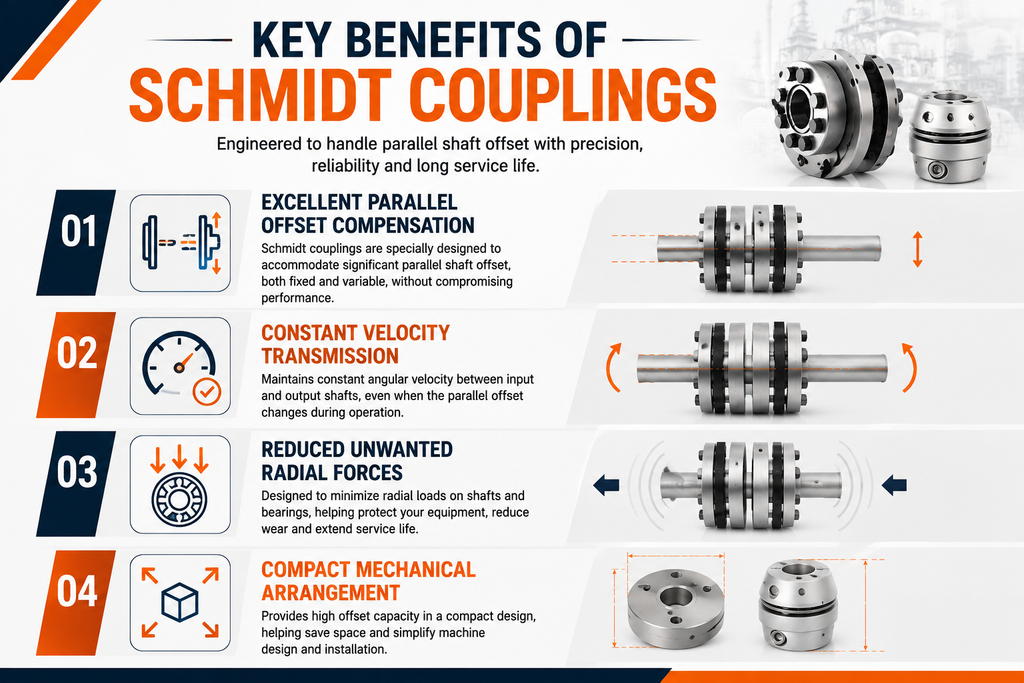
A Schmidt coupling offers several advantages over conventional coupling arrangements when parallel offset is the primary challenge.
1. Excellent Parallel Offset Compensation
The biggest advantage is its ability to accommodate significant parallel shaft displacement.
Fixed and Variable Offset
The technology can be considered for both fixed offset arrangements and applications where the distance between shaft centre lines changes during operation.
This makes it useful for specialised industrial machinery where conventional flexible couplings may not provide sufficient offset capability.
2. Constant Velocity Transmission
Maintaining rotational synchronisation is important in many precision applications.
Why Constant Velocity Matters
If the input and output shafts need to maintain a consistent rotational relationship, uncontrolled speed variation can affect machine performance.
A Schmidt coupling is designed to maintain constant angular velocity while accommodating radial displacement.
3. Reduced Unwanted Radial Forces
Coupling selection can directly affect the loads transferred to shafts and bearings.
Protecting Connected Equipment
A properly selected Schmidt coupling can accommodate the required parallel movement without relying on excessive restoring forces from the coupling.
This can help reduce unnecessary mechanical loading on nearby components.
4. Compact Mechanical Arrangement
Space limitations are common in industrial machinery.
Alternative to Long Shaft Arrangements
A specialised parallel offset coupling can sometimes eliminate the need for complicated intermediate shaft arrangements.
This gives machine designers more flexibility when designing compact equipment.
Where Are Schmidt Couplings Used?
Schmidt couplings are particularly relevant to machinery where parallel shaft movement is an inherent requirement.
Printing and Converting Machinery
Printing and converting equipment often contains multiple rollers that must remain synchronised.
Maintaining Roller Synchronisation
The coupling can help transmit rotational movement between displaced shafts while maintaining the required rotational relationship.
Paper Processing Equipment
Paper processing machinery can involve moving or adjustable components.
Handling Changing Shaft Positions
Where shaft positions change during operation, a specialised offset coupling can provide an alternative to conventional flexible coupling arrangements.
Metal Processing Machinery
Metal processing equipment can involve demanding loads and moving mechanical components.
Rolling and Forming Applications
Applications involving rolls or forming equipment may benefit from a coupling specifically designed to accommodate parallel shaft displacement.
Automated Machinery
Automation systems frequently require compact and precise mechanical arrangements.
Space and Synchronisation
Where shafts need to remain synchronised while operating at different physical positions, a Schmidt coupling may provide a practical solution.
Schmidt Coupling vs Conventional Flexible Coupling
Not every application requires a specialised offset coupling.
When Is a Conventional Coupling Enough?
A standard flexible coupling may be appropriate when the shafts have relatively small amounts of angular, parallel, or axial misalignment.
Typical Considerations
Selection normally depends on:
Torque
The coupling must safely transmit the required operating and peak torque.
Speed
The coupling should be suitable for the machine’s operating RPM.
Misalignment
The expected shaft movement must remain within the coupling’s permissible limits.
Environment
Temperature, dust, moisture and other conditions can influence coupling selection.
When Should You Consider a Schmidt Coupling?
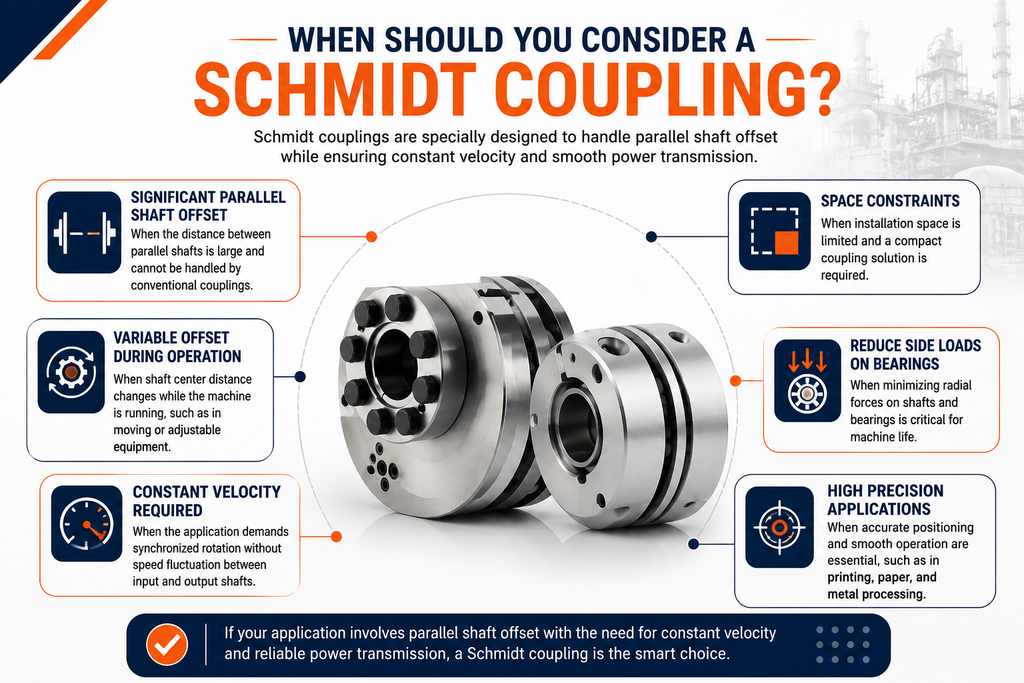
A Schmidt coupling becomes particularly relevant when:
The Parallel Offset Is Significant
The shaft centre lines may be separated by a distance that exceeds the practical capability of conventional flexible couplings.
The Offset Changes During Operation
The shaft position may move continuously or periodically as part of the machine’s normal operation.
Constant Velocity Is Important
The connected shafts need to maintain a controlled rotational relationship despite radial displacement.
Schmidt Coupling vs Other Specialised Couplings
Different coupling technologies solve different mechanical problems.
Schmidt Kupplung
The Schmidt Kupplung is specifically associated with parallel offset applications where controlled radial displacement and synchronised rotation are required.
SGF Coupling
An SGF Coupling can be considered for specialised industrial drive arrangements where the required torque transmission and mechanical movement match its design characteristics.
Alignment Eliminator
An Alignment Eliminator addresses applications where shaft alignment challenges are a significant part of the machine design.
Important Difference
The specific operating principle and permissible movement of each coupling should be evaluated before making a selection.
Constant Velocity Joint
A Constant Velocity Joint can transmit rotational movement while accommodating changes in shaft angle.
When It May Be Suitable
It can be considered where angular movement is the primary requirement rather than substantial parallel shaft offset.
How to Select a Schmidt Coupling
Selecting the right coupling should start with accurate machine data.
Important Parameters
Provide the following information before selecting a model:
Torque and Power
Determine the required transmitted torque and connected motor power.
Operating Speed
Record the normal and maximum operating RPM.
Shaft Dimensions
Measure the shaft diameters and available coupling connection dimensions.
Parallel Offset
Determine the minimum and maximum centre-to-centre shaft distance.
Movement During Operation
Identify whether the offset is fixed, periodic, or continuously changing.
Installation Space
Check the available radial and axial space around the coupling.
Operating Environment
Consider temperature, dust, moisture and other environmental conditions.
Installation and Maintenance Considerations
Correct installation is essential for achieving reliable coupling performance.
Verify Shaft Position
The shaft arrangement should be checked against the coupling’s permitted operating range.
Avoid Exceeding Rated Offset
Operating beyond the specified displacement can increase stress and reduce coupling life.
Inspect Coupling Components
During maintenance, inspect the mechanical elements for:
Wear
Look for abnormal wear on moving components.
Lubrication Requirements
Follow the manufacturer’s specified lubrication requirements where applicable.
Unusual Vibration
Unexpected vibration may indicate alignment, loading, installation or coupling problems.
Final Thoughts
Schmidt couplings are not simply another type of flexible coupling. Their main value lies in solving a specialised engineering challenge: transmitting torque between parallel shafts while accommodating substantial or changing offset.
For printing, paper processing, metalworking, rolling, forming and specialised automated machinery, this capability can simplify machine design while maintaining controlled rotational transmission.
The correct solution ultimately depends on the machine’s torque, speed, shaft dimensions, offset, movement and operating environment.
For specialised applications, RSV Industries can help evaluate coupling options including Schmidt Kupplung, SGF Coupling, Alignment Eliminator, Constant Velocity Joint and Disc Coupling according to the actual requirements of the equipment.


