
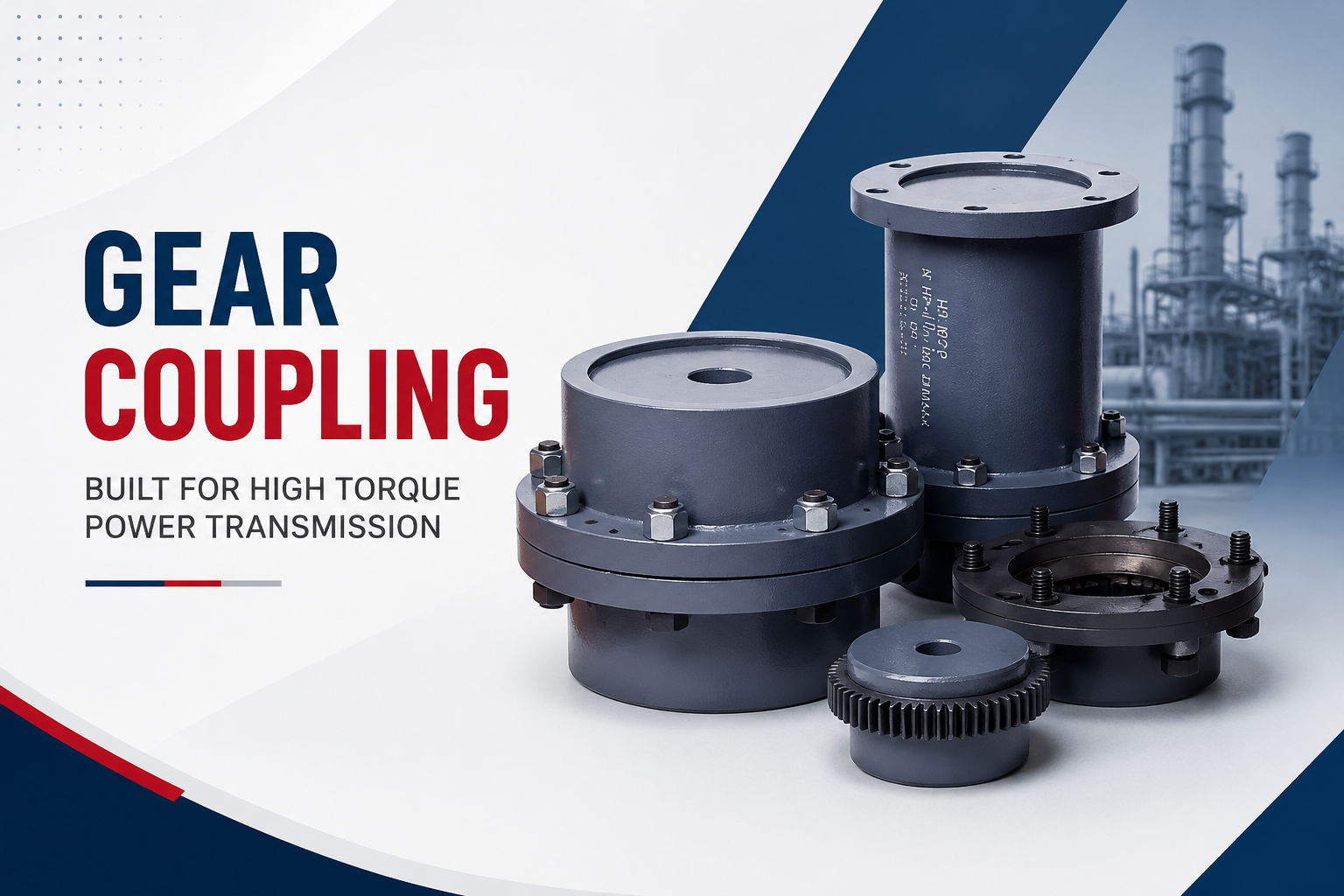
Industrial machinery depends on efficient power transmission systems to maintain smooth operations and reduce equipment failure. In industries such as steel plants, mining operations, cement manufacturing, marine systems, and heavy engineering, machinery works under high torque and continuous load conditions. To handle these demanding environments, industries commonly use gear coupling systems because of their strength, reliability, and ability to transfer high torque efficiently.
A gear coupling is one of the most widely used industrial couplings in heavy duty power transmission applications. It is specially designed to connect rotating shafts while compensating for small misalignment and transmitting torque with high efficiency.
To understand industrial coupling systems in detail, read Complete Guide to Industrial Couplings and Power Transmission Systems.
What is a Gear Coupling?
A gear coupling is a mechanical power transmission component used to connect two rotating shafts. It consists of external and internal gear teeth that work together to transfer torque between connected equipment.
Unlike standard couplings, gear couplings are designed to handle:
• high torque loads
• shaft misalignment
• shock loads
• continuous industrial operation
• heavy machinery applications
Because of their robust design, gear couplings are commonly used in industrial applications requiring stable torque transmission and long operational life.
Industries often compare gear couplings with Grid Coupling and Alignment Eliminator systems depending on machine requirements.
Main Components of a Gear Coupling
A gear coupling contains several important parts that help maintain smooth power transmission.
Hub
The hub contains external gear teeth connected directly to the machinery shaft.
Sleeve
The sleeve contains internal gear teeth that mesh with the hub teeth for torque transmission.
Gear Teeth
The specially designed gear teeth allow controlled movement while transmitting rotational power efficiently.
Lubrication System
Most industrial gear couplings require lubrication to reduce wear and improve operational life.
How Does a Gear Coupling Work?
A gear coupling works through the engagement of external and internal gear teeth. When the driving shaft rotates, torque is transferred through the gear teeth to the connected shaft.
The coupling allows slight shaft movement while maintaining smooth torque transmission.
The working process includes:
• transmitting rotational power
• compensating for shaft misalignment
• reducing equipment stress
• supporting heavy loads
• maintaining stable machine performance
In high precision industrial systems, industries also use Constant Velocity Joint solutions where smooth rotational movement at varying angles is required.
Types of Gear Couplings
Different industrial applications require different types of gear couplings.
Full Gear Coupling
This type contains gear teeth on both hubs and sleeves for high torque industrial applications.
Applications include:
• steel plants
• mining systems
• heavy machinery
Half Gear Coupling
Half gear couplings are used in systems requiring limited movement and moderate torque transfer.
Flexible Gear Coupling
Flexible gear couplings are designed to compensate for shaft movement while maintaining efficient power transmission.
For vibration control applications, industries may also compare these systems with TB WOODS coupling solutions.
Industrial Applications of Gear Couplings
Gear couplings are widely used across various industries.
Steel Industry
Applications include:
• rolling mills
• crushers
• conveyor systems
Mining Industry
Applications include:
• drilling systems
• material handling equipment
• heavy conveyors
Cement Industry
Applications include:
• rotary kilns
• crushers
• grinding mills
Power Generation Industry
Applications include:
• turbines
• pumps
• compressors
For heavy industrial applications requiring vibration absorption, industries often use Grid Coupling systems alongside gear couplings.
Factors to Consider When Selecting a Gear Coupling
Choosing the right gear coupling depends on several factors.
Torque Requirements
The coupling should support machinery load requirements.
Shaft Misalignment
Understanding shaft movement helps select the proper coupling type.
Operating Environment
Temperature, dust, moisture, and vibration affect coupling performance.
Maintenance Requirements
Lubrication and inspection requirements should be considered before installation.
To understand coupling selection methods, read How to Choose the Right Industrial Coupling for Heavy Machinery.
Gear Coupling vs Other Industrial Couplings
| Coupling Type | Main Advantage |
| Gear Coupling | High torque transmission |
| Grid Coupling | Better vibration absorption |
| Alignment Eliminator | Improved shaft alignment |
| Constant Velocity Joint | Smooth rotational movement |
| TB WOODS Coupling | Flexible industrial applications |
Final Thoughts
Gear couplings remain one of the most reliable solutions for industrial power transmission systems. Their ability to handle heavy loads, compensate for shaft movement, and operate in demanding industrial conditions makes them essential for heavy machinery applications.
Industries looking for efficient and durable power transmission solutions often combine gear couplings with technologies such as Alignment Eliminator, Constant Velocity Joint, Grid Coupling, and TB WOODS systems to improve operational efficiency and equipment performance.
Frequently Asked Question About Gear Couplings
What is a gear coupling used for?
Gear couplings are used to connect rotating shafts and transmit high torque in industrial machinery.
How does a gear coupling work?
Gear couplings work through meshing internal and external gear teeth that transfer rotational power between shafts.
What industries use gear couplings?
Steel plants, mining industries, cement plants, marine systems, and power generation facilities commonly use gear couplings.
What are the advantages of gear couplings?
Gear couplings provide high torque capacity, shaft misalignment compensation, durability, and reliable industrial performance.
Do gear couplings require lubrication?
Yes, most industrial gear couplings require lubrication to reduce wear and improve operational life.
What is the difference between gear coupling and grid coupling?
Gear couplings focus on high torque transmission, while grid couplings are better for vibration absorption and shock load reduction.
Why are gear couplings important in heavy machinery?
Gear couplings improve power transmission efficiency and help heavy machinery operate smoothly under demanding conditions.
What is a Gear Coupling and How Does it Work?
Reliable gear coupling systems for industrial machinery offering efficient torque transmission, durability, and smooth heavy duty operation.
What is the difference between full gear coupling and half gear coupling?
A full gear coupling has external gear teeth on both hubs, with each hub meshing into its own internally toothed sleeve. This design handles higher torque and is common in steel plants and mining equipment. A half gear coupling has only one hub with gear teeth engaged; the other side connects rigidly. It’s used where movement needs to stay limited on one end of the shaft, such as in compact drive assemblies.
How long does a gear coupling last?
A well-maintained gear coupling typically lasts several years in continuous industrial service, though actual life depends on load, misalignment, and lubrication schedule. Gear couplings run on sliding contact between the external and internal teeth, so they wear gradually rather than failing suddenly. Regular lubrication and inspection for correct alignment are what most extend service life; couplings run without adequate grease or oil wear out significantly faster.


