
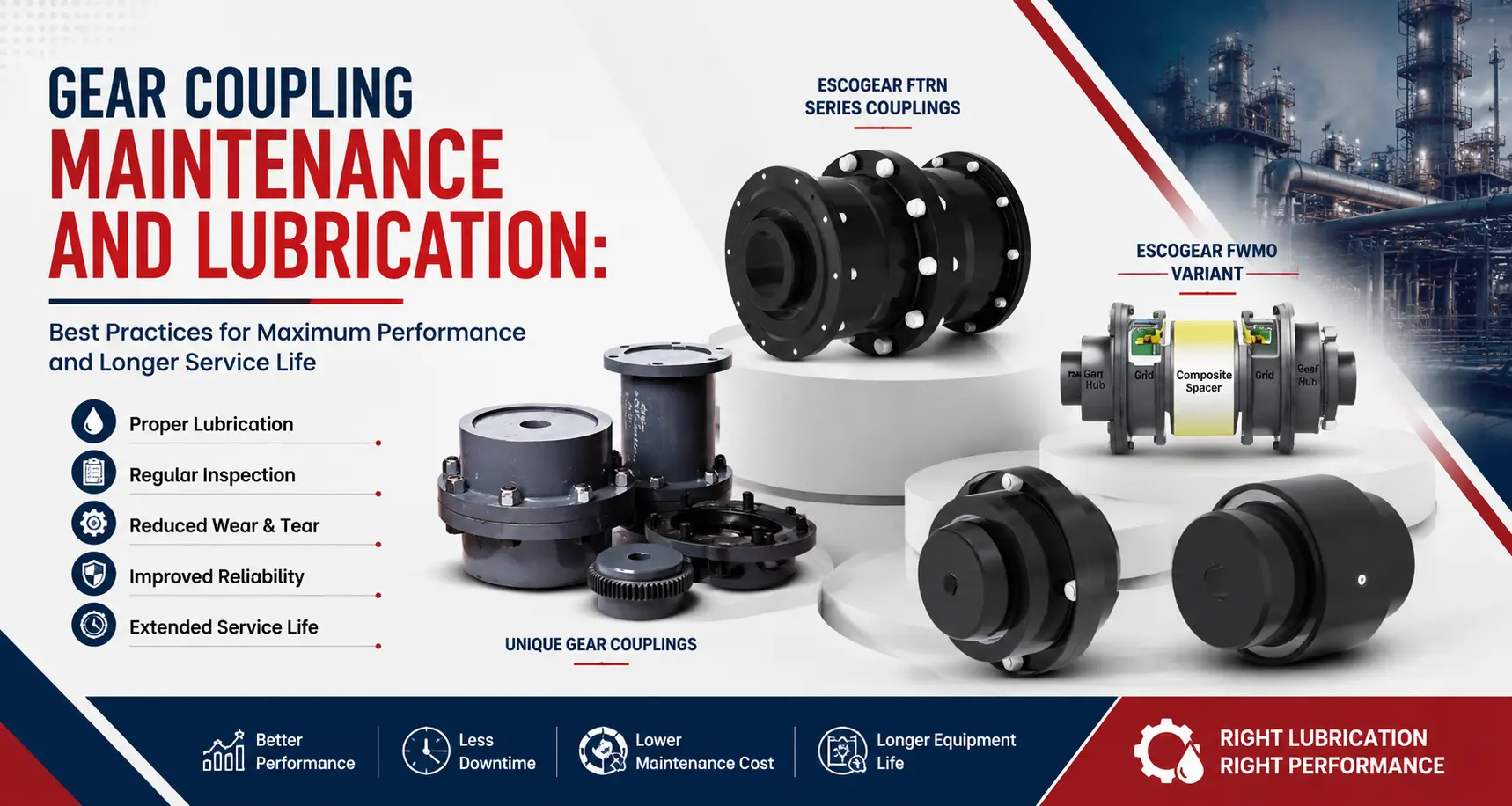
A gear coupling is one of the most heavily loaded, least glamorous parts in rotating machinery and one of the most expensive to replace on short notice. As a type of industrial coupling, it transmits torque between two shafts in rolling mills, crushers, conveyors, cement plants, and marine drives, often under high load and constant vibration. Treated as a “fit-and-forget” part, a gear coupling quietly wears down until it fails at the worst possible moment. Treated correctly, the same coupling can run for years past its expected life.
This guide brings together the practical maintenance checklist every plant technician needs and the lubrication science that actually determines how long your coupling lasts plus a maintenance schedule and mistakes to avoid, so you have one complete reference instead of piecing it together from multiple sources.
Understanding Gear Coupling Types Before You Maintain Them
Not all gear couplings are maintained the same way, so it helps to know what you’re working with:
- Flexible gear couplings use crowned, hardened gear teeth on a sleeve and hub to allow for shaft misalignment while transmitting high torque. These are the most common type in heavy industrial drives and require regular lubrication.
- Rigid gear couplings have little to no misalignment tolerance and are used where shaft alignment is tightly controlled.
- Continuous-lube gear couplings are sealed and connected to a circulating oil system, common in high-speed or high-load applications like reduction gearboxes.
Knowing your coupling type determines your lubricant choice, re-lubrication interval, and inspection method so confirm this first, ideally against the manufacturer’s datasheet, before setting a maintenance plan.
Choosing the Right Lubricant: Grease vs. Oil
Lubrication is the single biggest factor in gear coupling life, and the wrong choice does as much damage as no lubrication at all.
Grease-lubricated couplings are the standard for most flexible gear couplings. A good coupling grease needs:
- High base oil viscosity to maintain a film under heavy tooth loads
- Strong centrifugal resistance so it doesn’t sling out of the coupling at operating speed
- Extreme-pressure (EP) additives to protect gear tooth flanks under shock loading
- Good oxidation resistance, since coupling greases run at elevated temperatures for long stretches between service intervals
Oil-lubricated (continuous-lube) couplings are used in high-speed or high-torque applications, typically drawing from the same reservoir as an adjacent gearbox. Oil viscosity should be matched to operating speed and temperature too thin and the film breaks down under load; too thick and it generates excess heat and drag.
Always use the lubricant grade specified by your coupling manufacturer rather than “whatever is on the shelf.” Mixing incompatible greases, or switching lubricant types without flushing the old one out fully, is one of the fastest ways to cause premature tooth wear.
Building a Lubrication Schedule That Actually Gets Followed
Most coupling failures traced back to lubrication aren’t caused by using the wrong grease they’re caused by skipped intervals. Grease hardens, oxidizes, and mixes with metal fines over time even if the coupling is running fine. Build your schedule around three checks:
- Follow the manufacturer’s interval, not a general rule of thumb. Load, speed, and ambient temperature all shift how often relubrication is needed.
- Check the lube spot for consistency and metal content, not just level. Grease with fine metal particles suspended in it signals tooth wear already in progress.
- Watch for leakage at seals. Grease or oil weeping out usually means a damaged seal or overfilling both need inspection before more lubricant is simply added on top.
Keep the Coupling Clean and Free of Contaminants
Dust, metal chips, and grit around a gear coupling act like abrasive sand once they work into the gear teeth, wearing down the tooth profile far faster than normal operation would. Make cleaning part of the same routine as lubrication checks:
- Use a soft brush or cloth with a mild degreaser around the coupling housing
- Avoid high-pressure water jets directly on the coupling they drive contaminants past seals rather than removing them
- Keep the surrounding area free of metal shavings from nearby machining or grinding operations
Monitor Alignment and Vibration Closely
Flexible gear couplings are designed to tolerate a defined range of shaft misalignment but misalignment beyond that range doesn’t just get absorbed quietly. It shows up as increased load on the teeth, bearings, and supporting structure.
- Any new or unusual vibration from the coupling area should be investigated immediately, not assumed to be normal running noise
- Use laser alignment tools or dial indicators during scheduled maintenance rather than relying on visual checks
- Recheck alignment after any foundation work, bearing replacement, or major process change nearby, since these commonly shift shaft position
Don’t Overlook Bolts and Fasteners
The bolts holding gear coupling halves together carry as much responsibility as the gear teeth themselves. Vibration and load cycling gradually loosen fasteners, and a loose coupling can slip, shift sideways, or fail outright under load.
During every maintenance cycle:
- Inspect for elongated, cracked, or visibly under-tightened bolts
- Torque all fasteners to the manufacturer’s specified values, in the correct sequence
- Replace, rather than reuse, any bolt showing thread damage or deformation
Watch Temperature and Noise as Early Warning Signs
A healthy gear coupling runs quietly and stays within a stable temperature range. Rising temperature near the coupling or adjacent bearings, or new grinding, clicking, or metal-on-metal sounds, almost always trace back to one of three causes: poor lubrication, misalignment, or worn gear teeth. Catching these signs early turns a scheduled inspection into a five-minute fix instead of an unplanned shutdown.
Common Maintenance Mistakes to Avoid
- Topping up grease without checking why it was low. Leakage or overfilling needs a root cause, not just a refill.
- Ignoring “minor” vibration because the machine is technically still running.
- Using generic grease instead of the EP-rated, high-viscosity grease specified for gear couplings.
- Skipping bolt torque checks because the coupling “looks fine” from the outside.
- Waiting for a shutdown to inspect, rather than building coupling checks into routine rounds.
A Simple Maintenance Schedule to Follow
| Task | Frequency |
|---|---|
| Visual inspection for leaks, noise, heat | Weekly |
| Cleaning around coupling housing | Weekly |
| Grease/oil condition check | Monthly |
| Bolt torque verification | Quarterly |
| Full relubrication | As per manufacturer interval |
| Laser alignment check | Annually, or after major maintenance nearby |
Getting More Life from Your Gear Coupling
Extending gear coupling life comes down to consistency, not complexity: use the correct lubricant, follow the schedule instead of reacting to problems, keep the area clean, and treat vibration, heat, and noise as signals worth stopping for. A five-minute check today is almost always cheaper than an unplanned failure tomorrow.
Explore our full range of industrial coupling solutions on our homepage, or get in touch with our team for coupling selection, lubrication guidance, or maintenance support suited to your specific machinery.


