
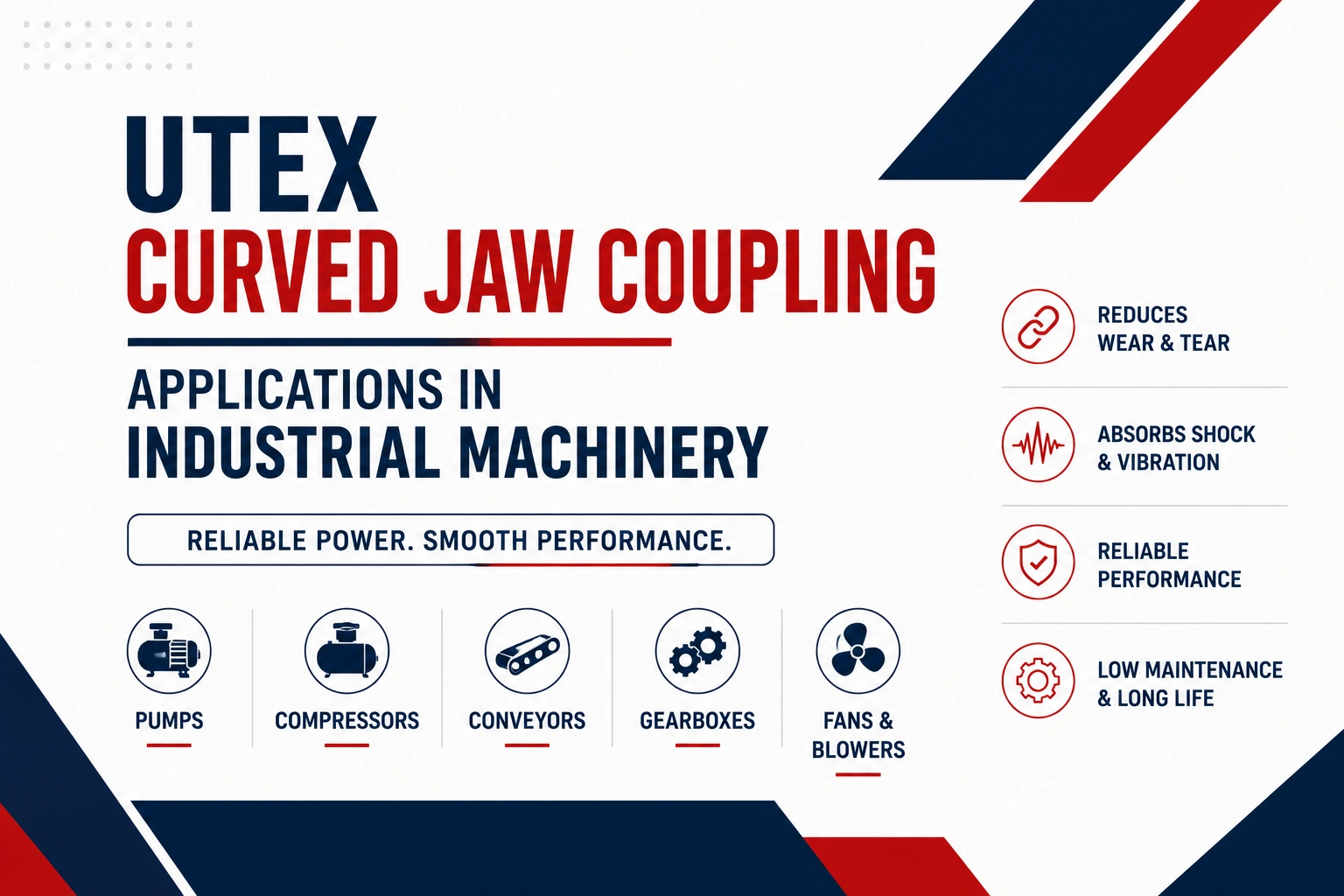
Every rotating machine in a plant a pump, a motor, a compressor, a conveyor drive depends on one small, unglamorous component to keep running smoothly: the shaft coupling. Get it wrong, and you get vibration, premature bearing wear, and unplanned downtime. Get it right, and the coupling quietly does its job for years without anyone noticing it exists.
The UTEX curved jaw coupling is one of the most widely specified couplings in Indian and global industrial machinery for exactly this reason. It is simple, maintenance-free, and forgiving of the small alignment errors that are unavoidable in real-world installations. This guide covers what a UTEX curved jaw coupling is, how it works, where it is used across industrial machinery, and how to select and maintain one correctly.
Key Takeaways
- A UTEX curved jaw coupling connects two shafts using two metal jaw hubs and a flexible elastomer “spider” sandwiched between them.
- The curved jaw profile spreads load more evenly across the spider than a straight jaw design, reducing stress concentration and extending service life.
- It transmits torque, dampens vibration, and absorbs angular, parallel, and axial misalignment all without lubrication.
- It is a standard choice for pumps, compressors, blowers, fans, conveyors, gearboxes, mixers, and generator sets across manufacturing, process, power, and material handling industries.
- The elastomer spider (NBR, polyurethane, or Hytrel) determines torque capacity, damping, temperature range, and misalignment tolerance selecting the right material is the single most important sizing decision.
What Is a UTEX Curved Jaw Coupling?
A UTEX curved jaw coupling is a three-piece flexible shaft coupling: two identical metal hubs, each machined with curved jaw lobes, mounted on the driving and driven shafts, with a star-shaped elastomer spider fitted between the interleaved jaws. Torque passes from the drive shaft, through the jaws of the first hub, into the compressed lobes of the spider, and out through the jaws of the second hub to the driven shaft.
Because the elastomer spider not metal carries the torque, the coupling flexes slightly under load. That flexibility is the entire point: it lets the coupling absorb the small amounts of angular, parallel, and axial misalignment that exist in every real installation, cushion shock loads at startup, and damp torsional vibration before it reaches bearings, seals, and gearboxes downstream.
The “UTEX” designation refers to this curved-jaw-with-spider coupling family as supplied by Indian power transmission manufacturers and distributors, and it is functionally equivalent to the curved-jaw or “L-type” spider couplings sold internationally under other manufacturer names.
How Curved Jaw Couplings Work: Construction and Mechanism
A UTEX curved jaw coupling has three core components:
- Two hubs — precision-machined from steel, stainless steel, or aluminium, bored to match the driving and driven shaft diameters and secured with a set screw or keyway.
- An elastomer spider — a star-shaped insert with lobes that sit between the jaws of the two hubs, transmitting torque purely in compression.
- Jaw profile — the curved (as opposed to straight) lobe geometry machined into the face of each hub, which is what distinguishes a curved jaw coupling from a standard straight-jaw design.
When the drive shaft rotates, each hub jaw pushes against a spider lobe rather than against the opposite hub directly. This means the two hubs never touch each other in normal operation all torque transfer happens through the compressed elastomer. If the spider ever wears out completely, the metal jaws of the two hubs mesh and continue driving the load (noisily) until the equipment can be safely shut down for maintenance a built-in fail-safe behaviour that is one of the main reasons jaw-type couplings remain a default choice in critical drive lines.
Curved Jaw vs Straight Jaw: Why the Curve Matters
Straight jaw couplings load the spider in a narrow contact band, concentrating stress at the root of each lobe. A curved jaw profile increases the contact area between the jaw face and the spider leg, spreading the compressive load more gradually along the lobe. In practice, this delivers three measurable benefits over a straight jaw design:
- Lower stress concentration at the spider root, which extends spider life under repeated or shock loading.
- Slightly higher angular misalignment tolerance, since the curved geometry accommodates shaft deflection without edge-loading the elastomer.
- Better performance under fluctuating and reversing loads, which is common in compressor, crusher, and conveyor drives.
This is why curved jaw couplings, including the UTEX range, tend to be specified in preference to straight jaw designs wherever shock loading, frequent starts/stops, or higher torque density in a compact envelope are factors.
Key Technical Parameters for Sizing
Selecting the correct UTEX curved jaw coupling size requires matching the coupling’s rating to the actual demands of the drive line, not just the nominal motor power. The main parameters to check are:
| Parameter | Why It Matters |
| Continuous torque rating | Catalogue torque ratings are nominal, steady-state figures — actual selection should include a service factor for shock, starting, and reversing loads. |
| Shaft bore diameter and keyway | The hub bore must match both driving and driven shaft diameters, with keyway dimensions per standard. |
| Operating speed (RPM) | Some spider constructions have maximum speed limits, particularly open-centre designs. |
| Angular, parallel, and axial misalignment | Each spider material has a rated misalignment envelope — exceeding it accelerates wear and defeats the purpose of a flexible coupling. |
| Ambient and operating temperature | Determines whether NBR, polyurethane, or Hytrel is appropriate. |
| Shock and starting loads | Frequent start-stop-reverse duty (crushers, mixers, cranes) needs a spider rated for cyclic shock, not just steady torque. |
| Space envelope | Compact drive layouts may favour curved jaw over other flexible coupling types purely on footprint. |
Applications of UTEX Curved Jaw Couplings in Industrial Machinery
UTEX curved jaw couplings show up wherever a rotating prime mover needs to be connected to a driven machine with some tolerance for misalignment and vibration. The most common equipment applications include:
Pumps
Centrifugal and positive-displacement pumps are one of the most common applications for curved jaw couplings. The spider absorbs the pulsation and minor shaft deflection typical of pump operation while protecting the motor bearings and pump seals from transmitted vibration.
Compressors and Blowers
Reciprocating and rotary compressors generate pulsating, sometimes reversing torque loads. A correctly specified spider often polyurethane or Hytrel for the higher torque density cushions these pulses before they reach the gearbox or motor shaft.
Electric Motors and Gearboxes
Motor-to-gearbox and motor-to-driven-equipment connections are the textbook use case: the coupling compensates for the inevitable small misalignment between motor and driven shaft centrelines, particularly after re-alignment during maintenance.
Fans and Blowers
Industrial fans, especially those with variable duty cycles, benefit from the torsional damping a jaw coupling provides, reducing resonance-related vibration transmitted to bearings.
Conveyors and Material Handling Equipment
Light- to medium-duty conveyor drives use curved jaw couplings to absorb the shock loading that occurs when a conveyor starts under load or encounters an obstruction, protecting gear reducers from impact torque.
Mixers and Agitators
Mixers subject couplings to variable and often reversing torque as viscosity and load change; the elastomer spider’s damping characteristic smooths out these fluctuations.
Generator Sets
Between an engine and an alternator, a jaw coupling with a high-temperature spider (typically Hytrel) absorbs the torsional shock of engine firing pulses and startup loads.
Crushers and Screening Equipment
Where shock loading is severe and continuous, the curved jaw geometry’s improved load distribution and fail-safe jaw-lock behaviour make it a preferred choice over more rigid coupling types.
Industry-Wise Applications
Because they are compact, maintenance-free, and available across a wide torque range, UTEX curved jaw couplings are used across a broad span of industrial sectors:
- Manufacturing and general engineering — machine tool drives, general power transmission
- Process and chemical industries — pump and agitator drives handling corrosive or high-temperature media
- Power generation and utilities — auxiliary drives, cooling systems, generator sets
- Material handling — conveyors, elevators, cranes
- Cement and mining — crushers, screens, and conveyor systems subject to heavy shock loading
- Oil and gas — pump and compressor drives in processing facilities
- Water and wastewater treatment — pump station drives requiring low-maintenance, corrosion-tolerant couplings
- Textile and pharmaceutical manufacturing — precision drives where vibration control protects product quality
- Paper and packaging machinery — roll and drive-line couplings requiring smooth torque transmission
Advantages of UTEX Curved Jaw Couplings
- No lubrication required — the elastomer spider operates dry, eliminating a routine maintenance task altogether.
- Fail-safe design — if the spider fails, the jaws mesh and keep the drive running until a planned shutdown.
- Compact footprint — well suited to close-coupled installations where space is limited.
- Broad misalignment tolerance — accommodates angular, parallel, and axial misalignment without the need for precision alignment equal to rigid couplings.
- Vibration and shock absorption — protects motors, gearboxes, bearings, and seals from transmitted torsional loads.
- Easy inspection and replacement — the spider can typically be visually inspected and swapped without disturbing shaft alignment.
- Wide torque and bore range — available across small motor-pump sets through to heavy industrial drive lines, depending on spider material and hub size.
Installation Best Practices
- Check shaft alignment before installation. A flexible coupling extends component life by absorbing minor misalignment it is not a substitute for reasonable alignment practice.
- Maintain the correct gap between hubs as specified by the coupling drawing, so the spider is neither compressed excessively nor left loose.
- Torque set screws or keyway fasteners to the specified value under-tightening is a common cause of hub creep and premature wear.
- Inspect the spider before commissioning for any shipping or handling damage.
- Verify shaft-to-bore fit and confirm keyway dimensions match the coupling hub before mounting.
Maintenance and Common Failure Modes
Although UTEX curved jaw couplings are low-maintenance, periodic visual inspection extends service life and prevents unplanned downtime. Watch for:
- Spider wear or cracking — visible as rubber dust around the coupling or increased vibration; replace the spider before it fails completely.
- Excessive misalignment — uneven spider wear on one side usually indicates the shafts have drifted out of alignment and need re-checking.
- Overheating — discoloration or a burnt-rubber smell signals the spider material is unsuited to the operating temperature or torque load.
- Chemical degradation — swelling or softening of the elastomer indicates exposure to incompatible oils, solvents, or process chemicals; consider switching to a more resistant spider material.
- Unusual noise from metal-to-metal contact — this typically means the spider has already failed and the jaws are running in their fail-safe interlocked mode; schedule immediate replacement.
How to Select the Right UTEX Curved Jaw Coupling: A Quick Checklist
- Confirm continuous and peak (shock) torque requirements of the application
- Confirm shaft diameters, keyway sizes, and required bore tolerance for both driving and driven equipment
- Check maximum operating speed against the spider construction’s rated RPM
- Identify expected angular, parallel, and axial misalignment
- Match ambient and operating temperature to an appropriate spider material (NBR, polyurethane, or Hytrel)
- Account for duty cycle continuous running versus frequent start/stop/reverse operation
- Confirm available installation envelope (space between shaft ends)
- Consider chemical or oil exposure at the installation site
Frequently Asked Questions
What is a UTEX curved jaw coupling used for? It is used to transmit torque between two rotating shafts such as a motor and a pump, compressor, or gearbox while absorbing vibration and accommodating minor shaft misalignment in industrial machinery.
How is a curved jaw coupling different from a straight jaw coupling? The curved jaw profile increases the contact area between the hub and the spider, distributing load more evenly and improving both spider life and angular misalignment tolerance compared to a straight jaw design.
Does a UTEX curved jaw coupling need lubrication? No. The elastomer spider operates dry, which is one of the main reasons jaw couplings are considered low-maintenance compared to gear or chain couplings.
Which spider material should I choose? NBR is the general-purpose default with the best damping and misalignment tolerance. Choose polyurethane for higher torque in the same hub size, and Hytrel for high-temperature or high-torque applications where reduced damping is acceptable.
What happens if the elastomer spider fails? Jaw couplings are fail-safe: the metal jaws of the two hubs mesh together and continue driving the load, allowing the equipment to be shut down safely for maintenance rather than stopping unexpectedly.
Can UTEX curved jaw couplings handle shock loads? Yes. Absorbing shock and torsional vibration is one of their primary functions, which is why they are widely used on compressors, crushers, conveyors, and generator sets where load fluctuates.
What industries commonly use these couplings? Manufacturing, process and chemical plants, power generation, material handling, cement and mining, oil and gas, water treatment, textile, pharmaceutical, and paper and packaging industries all use curved jaw couplings across various drive applications.
Conclusion
The UTEX curved jaw coupling earns its place as a default choice in industrial power transmission because it solves several problems at once: it transmits torque reliably, tolerates the misalignment that is unavoidable in real installations, dampens vibration and shock before it reaches expensive downstream components, and does all of this without requiring lubrication or heavy maintenance. From pumps and compressors to conveyors, mixers, and generator sets, its combination of simplicity, fail-safe operation, and a wide range of spider materials makes it adaptable across nearly every industrial sector.
Getting the full benefit of a curved jaw coupling comes down to correct sizing matching torque, speed, misalignment, and temperature requirements to the right hub and spider combination and following basic installation and inspection practices once it’s in service.


