
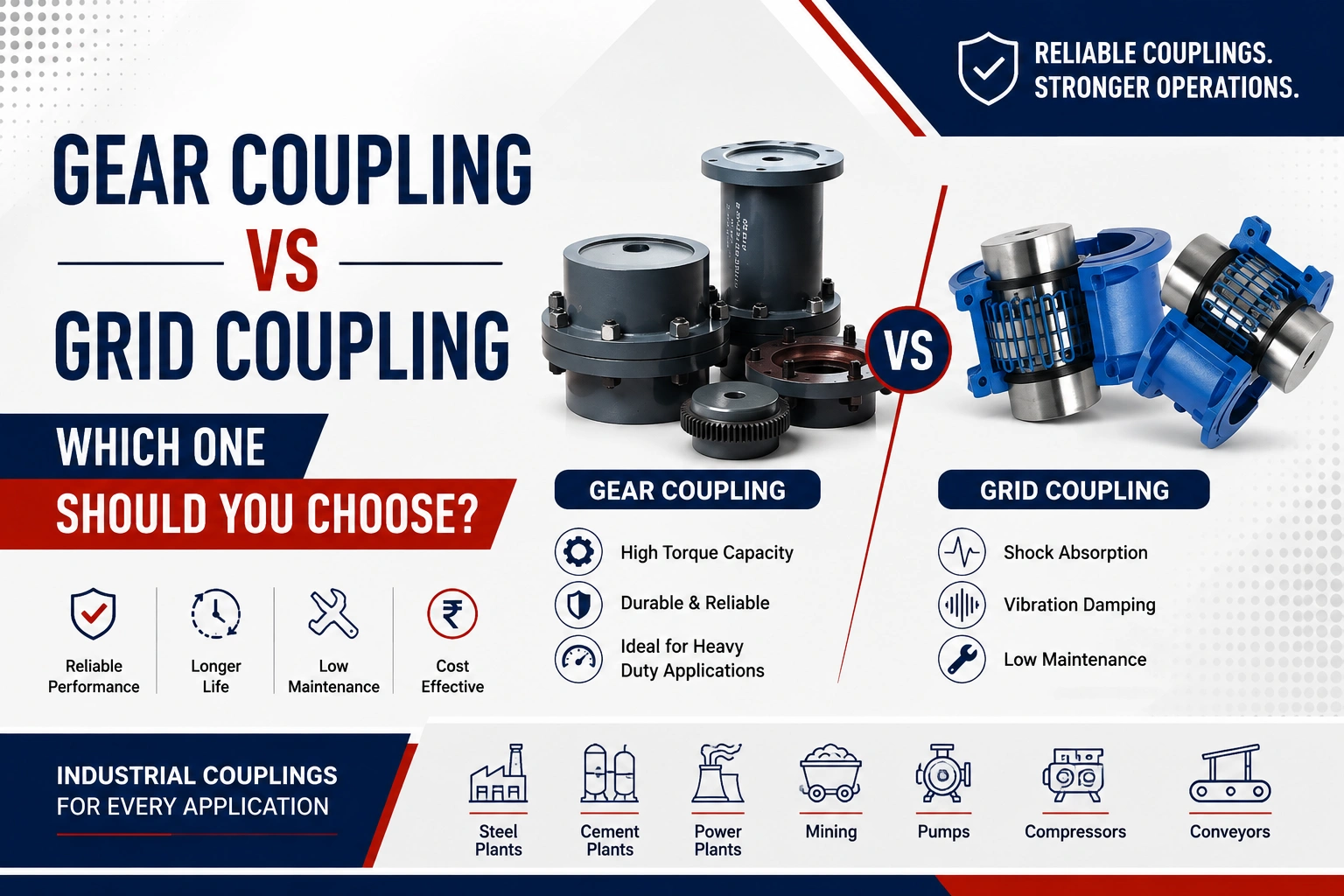
Industrial machinery relies on efficient power transmission to keep operations running smoothly. Whether you’re managing a steel plant, mining operation, cement factory, paper mill, or manufacturing facility, selecting the right coupling plays a vital role in equipment reliability, maintenance costs, and overall productivity.
Among the most widely used industrial shaft couplings are Gear Couplings and Grid Couplings. While both transmit torque between rotating shafts, they are engineered for different operating conditions. Understanding their construction, performance, maintenance requirements, and industrial applications will help you choose the best solution for your machinery.
If you’re searching for the best gear coupling for heavy duty applications or the best grid coupling for shock loads, this comprehensive comparison guide will help you make an informed decision.
What is a Gear Coupling?
A Gear Coupling is a heavy-duty flexible shaft coupling that uses precision-machined external and internal gear teeth to transmit high torque between connected shafts. It is specifically designed for demanding industrial environments where maximum torque transmission and continuous operation are essential.
Because of its robust construction, a high torque gear coupling is widely used in heavy industries requiring reliable power transmission under extreme operating conditions.
Key Features
- High torque transmission
- Compact and durable construction
- Suitable for high-speed applications
- Handles moderate shaft misalignment
- Excellent service life
- Reliable performance under continuous loads
Common Applications
- Steel plants
- Rolling mills
- Cement plants
- Mining equipment
- Crushers
- Heavy-duty conveyors
- Power generation
- Marine industries
What is a Grid Coupling?
A Grid Coupling consists of two grooved hubs connected by a high-strength spring steel grid. Unlike gear couplings, the flexible grid absorbs shock loads and dampens vibration before they reach connected equipment.
This unique design makes the flexible grid coupling one of the preferred choices for machinery subjected to vibration, impact loading, and frequent starts and stops.
Key Features
- Superior shock absorption
- Excellent vibration damping
- Easy maintenance
- Extended bearing life
- Reduced equipment wear
- Lower maintenance costs
Common Applications
- Conveyor systems
- Pumps
- Compressors
- Fans
- Blowers
- Material handling systems
- Crushers
Gear Coupling vs Grid Coupling: Comparison Table
| Feature | Gear Coupling | Grid Coupling |
|---|---|---|
| Torque Capacity | Excellent | Very Good |
| Shock Load Absorption | Moderate | Excellent |
| Vibration Reduction | Moderate | Excellent |
| Operating Speed | Very High | High |
| Misalignment Capacity | Moderate | Good |
| Lubrication | Required | Minimal |
| Maintenance | Moderate | Low |
| Best Applications | Steel Plants, Rolling Mills | Conveyors, Pumps, Crushers |
Gear Coupling Selection Guide
A proper Gear Coupling selection guide begins with understanding the operating conditions of your machinery. Gear couplings are ideal for applications where maximum torque transmission is more important than vibration isolation.
When selecting a gear coupling, consider:
- Required torque
- Operating speed (RPM)
- Shaft diameter
- Angular misalignment
- Parallel misalignment
- Ambient temperature
- Lubrication requirements
- Equipment type
If your machinery operates continuously under heavy loads, a gear coupling is often the preferred solution.
Grid Coupling Selection Guide
A Grid Coupling selection guide focuses on applications where shock absorption and vibration control are critical.
Grid couplings perform exceptionally well when equipment experiences:
- Frequent starts and stops
- Shock loading
- Variable loads
- Vibration
- Moderate shaft misalignment
These characteristics make them ideal for pumps, fans, conveyors, compressors, and material handling equipment.
Gear Coupling for Steel Plants
One of the most common industrial applications is the Gear Coupling for steel plants. Steel manufacturing equipment operates under extremely high torque and continuous production cycles, making gear couplings the preferred choice.
Typical steel plant applications include:
- Rolling mills
- Continuous casting machines
- Billet conveyors
- Cooling beds
- Slab handling systems
- Steel processing equipment
Their ability to transmit high torque while maintaining reliable performance makes gear couplings indispensable in steel manufacturing.
Grid Coupling for Conveyor Systems
A Grid Coupling for conveyor systems offers excellent vibration control and shock load absorption, protecting motors, gearboxes, and bearings from excessive stress.
Industries commonly using grid couplings include:
- Mining
- Cement
- Packaging
- Food processing
- Bulk material handling
- Warehousing
Their flexible spring grid helps reduce downtime while extending equipment life.
Gear Coupling Advantages
Gear couplings remain the first choice for many heavy-duty industrial applications because they provide:
Superior Torque Transmission
Their precision gear teeth allow efficient power transmission under extremely high loads.
Excellent High-Speed Performance
Gear couplings maintain stability at higher rotational speeds without compromising performance.
Heavy-Duty Construction
Manufactured from high-strength materials, they withstand demanding industrial environments.
Long Service Life
With proper lubrication and maintenance, gear couplings provide years of dependable operation.
Grid Coupling Advantages
Grid couplings offer several operational benefits that improve machine reliability.
Shock Load Absorption
The flexible spring grid absorbs sudden torque fluctuations before they damage connected equipment.
Reduced Vibration
Lower vibration improves equipment stability and extends bearing life.
Lower Maintenance
Compared to lubricated gear couplings, grid couplings generally require less maintenance.
Equipment Protection
Reduced shock loading minimizes wear on shafts, bearings, motors, and gearboxes.
Which Coupling is Better for Pumps?
One of the most frequently asked questions is Which coupling is better for pumps?
For most centrifugal and industrial pumps, Grid Couplings are the preferred choice because they:
- Absorb vibration
- Reduce bearing loads
- Improve alignment tolerance
- Extend pump life
However, heavy-duty process pumps operating under high torque may require a gear coupling.
Which Coupling is Better for Compressors?
If you’re wondering Which coupling is better for compressors, the answer depends on compressor size and operating conditions.
Gear Couplings are generally recommended for:
- Heavy-duty air compressors
- Gas compressors
- High-speed compressors
- Industrial process compressors
Grid couplings are suitable for moderate-duty compressor applications where vibration reduction is the primary objective.
Gear Coupling Maintenance Guide
Following a proper Gear Coupling maintenance guide helps maximize equipment life and minimize downtime.
Maintenance recommendations include:
- Regular lubrication
- Inspecting gear teeth
- Checking seals
- Shaft alignment verification
- Monitoring backlash
- Replacing worn components
Routine inspections significantly improve reliability.
Grid Coupling Installation Guide
A proper Grid Coupling installation guide recommends:
- Verify shaft alignment.
- Install both hubs securely.
- Insert the spring grid correctly.
- Install the coupling cover.
- Apply lubricant if specified.
- Perform vibration and alignment checks.
Correct installation ensures maximum performance and longer service life.
Gear Coupling Replacement Guide
A Gear Coupling replacement guide recommends replacing the coupling when you observe:
- Excessive gear tooth wear
- Lubricant leakage
- High vibration
- Shaft misalignment
- Cracked sleeves
- Excessive backlash
Replacing worn components before failure prevents costly production downtime.
Gear Coupling vs Grid Coupling Price
When comparing Gear Coupling vs Grid Coupling price, the initial purchase cost should not be the only consideration.
Instead, evaluate:
- Equipment life
- Maintenance cost
- Lubrication requirements
- Downtime
- Replacement frequency
- Overall operating cost
A properly selected coupling delivers significantly better long-term value than simply choosing the lowest-priced option.
Which Coupling Should You Choose?
Choose a Gear Coupling if your application requires:
- High torque transmission
- Continuous heavy-duty operation
- High-speed performance
- Steel plant machinery
- Rolling mills
- Crushers
- Heavy industrial equipment
Choose a Grid Coupling if your application requires:
- Shock absorption
- Vibration reduction
- Conveyor systems
- Pumps
- Fans
- Compressors
- Lower maintenance
Why Choose RSV Industries?
Selecting the right supplier is just as important as selecting the right coupling. RSV Industries has been serving industries for decades with reliable power transmission solutions tailored to demanding applications.
As one of India’s trusted Industrial coupling distributors, RSV Industries supplies premium coupling solutions for:
- Steel plants
- Cement plants
- Mining industries
- Paper mills
- Chemical industries
- Power generation
- Material handling systems
- Manufacturing facilities
Our comprehensive product portfolio includes high-performance Gear Coupling solutions for heavy-duty torque transmission and premium Hydax Coupling products designed for reliable, flexible power transmission across various industrial applications.
Our experienced technical team assists customers in selecting the most suitable coupling based on operating conditions, torque requirements, shaft alignment, and industry-specific challenges.
Final Thoughts
Both Gear Couplings and Grid Couplings are essential components in modern industrial power transmission systems. The right choice depends on your application’s torque requirements, operating environment, vibration levels, maintenance expectations, and equipment design.
If your machinery demands maximum torque capacity and continuous heavy-duty operation, a Gear Coupling is the ideal solution. If reducing vibration, absorbing shock loads, and minimizing maintenance are your priorities, a Grid Coupling offers significant advantages.
By understanding each coupling’s strengths and limitations, engineers can improve equipment reliability, reduce downtime, and lower long-term operating costs. Partnering with experienced Industrial coupling distributors like RSV Industries ensures you receive expert guidance and high-quality coupling solutions that keep your operations running efficiently for years to come.


