
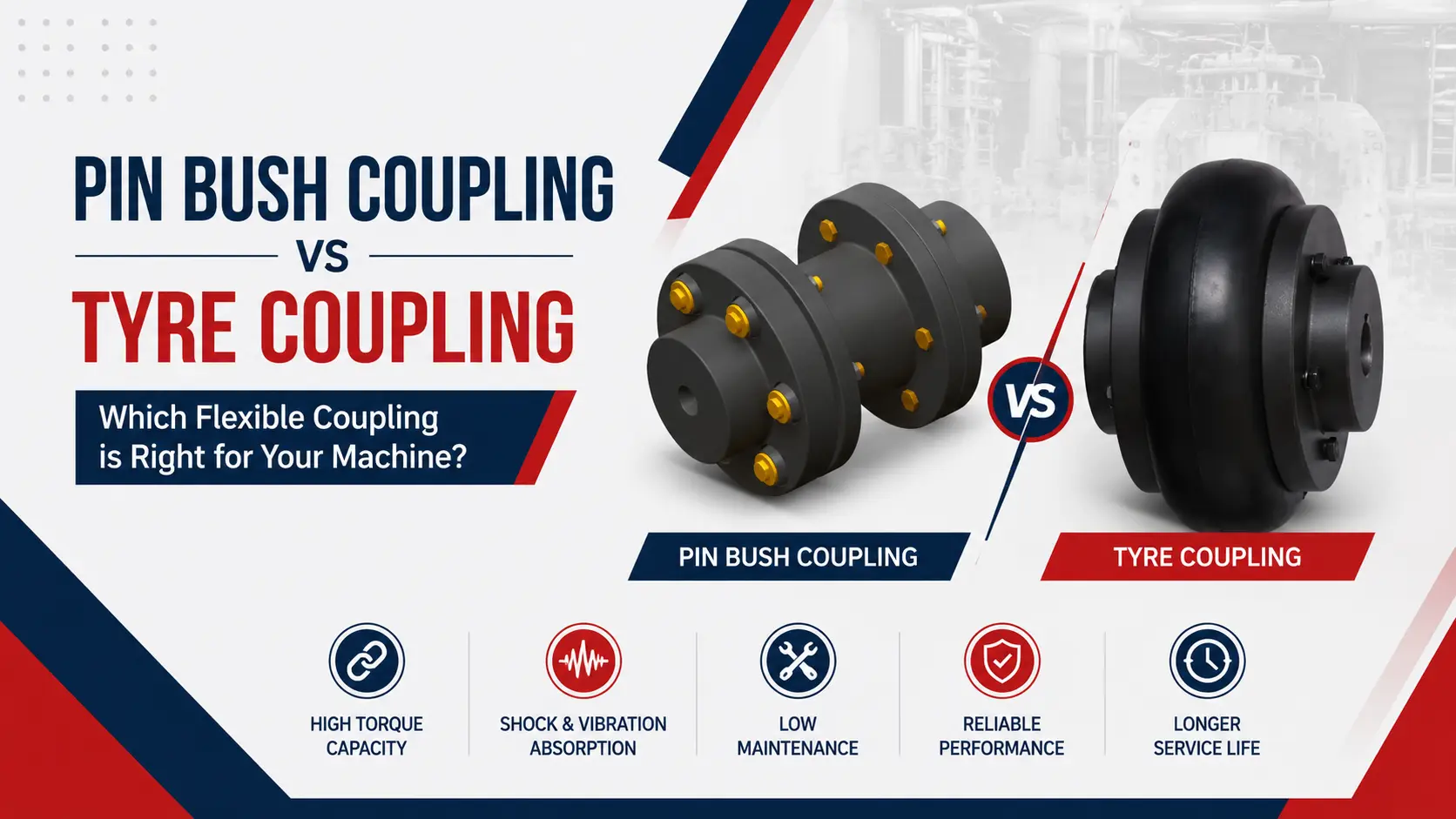
Choosing the right flexible shaft coupling can make or break the efficiency of your rotating machinery. Two of the most widely used options in industrial power transmission are the pin bush coupling and the tyre coupling. Both connect motors to driven equipment, absorb misalignment, and dampen shock but they aren’t interchangeable. Here’s a straight-to-the-point comparison to help you pick the right one.
What is a Pin Bush Coupling?
A pin bush coupling (also called a pin and bush coupling) uses a set of pins fitted with rubber or elastomeric bushes that connect two flanges. It’s a simple, cost-effective, and easy-to-maintain design widely used in pumps, blowers, compressors, and light-to-medium duty industrial motors.
Key advantages:
- Low initial cost and easy availability
- Simple installation and replacement
- Compact design, suitable for space-constrained setups
- Good for moderate torque and minor misalignment
Limitations:
- Bushes wear out faster under heavy shock loads
- Lower misalignment tolerance compared to tyre couplings
- Not ideal for high-torque, heavy-duty applications
What is a Tyre Coupling?
A tyre coupling uses a single continuous rubber tyre-shaped element bolted between two flanges instead of multiple pins. This design is popular in heavy-duty applications like crushers, conveyors, mixers, and high-torque industrial drives.
Key advantages:
- Superior shock absorption and vibration damping
- Handles higher angular, parallel, and axial misalignment
- No metal-to-metal contact offers electrical insulation between shafts
- Longer service life under heavy-duty, high-torque conditions
- Single-piece element makes replacement faster
Limitations:
- Higher upfront cost than pin bush couplings
- Slightly larger footprint
- May be overkill for light-duty applications
Pin Bush Coupling vs Tyre Coupling: Quick Comparison
| Factor | Pin Bush Coupling | Tyre Coupling |
|---|---|---|
| Cost | Lower | Higher |
| Torque Capacity | Low to Medium | Medium to High |
| Misalignment Tolerance | Moderate | High |
| Shock/Vibration Absorption | Good | Excellent |
| Maintenance | Frequent bush replacement | Less frequent, easier |
| Best For | Pumps, blowers, light motors | Crushers, conveyors, heavy machinery |
Which Coupling is Better?
There’s no universal winner the best coupling depends on your load, torque, and misalignment requirements:
- Choose a pin bush coupling if you need an economical, easy-to-maintain solution for light to medium-duty applications with steady loads.
- Choose a tyre coupling if your equipment faces high torque, heavy shock loads, or significant misalignment common in mining, cement, and heavy industrial machinery.
Final Thoughts
If uptime and durability under tough conditions matter most, a tyre coupling is the smarter long-term investment. If you’re working with a tighter budget and lighter loads, a pin bush coupling delivers reliable performance at a lower cost.
Still unsure which flexible coupling suits your machine? Consult with a coupling supplier who can assess your torque, speed, and misalignment requirements before you buy.


